Director: Yasuharu Hasebe
Starring: Tamaki Katsura, Yutaka Hayashi
Assault! Jack the Ripper is a Japanese horror film from Nikkatsu studios in their Violent Pink line. Pink films (also called "eroduction" or "Roman porno") are a genre of Japanese films that has no exact analog in the West.[1] Per studio guidelines, pink films contain a certain quota of sex scenes spaced at required intervals, making them similar to the softcore porn of Cinemax and Showtime ilk. But the stories are generally more complex and subtly psychological and quite often feature nuanced female characters unlike softcore porn.
Violent Pink (also called Pinky Violence) is a subgenre of Pink that involves violence, very often graphic in nature.
Much ink has been spilt breaking down the Western horror genre, including exploration of the representation of gender in horror. I'm intentionally not going to approach Assault! Jack the Ripper from that angle because of differences not only between American and Japanese culture but also because of the differences in the history of cinema and visual language in the two countries. Although a discussion of the abject or the targeting by the killer of sexually active women in horror films could potentially be fruitful in this case, I leave them aside. I will instead just discuss two major themes in the movie.
Wikipedia summarizes the plot of Assault! Jack the Ripper as: "A young couple engage in a rampage of murder, rape and mayhem in order to stimulate their sexual appetites." Succinct, it fails to describe the two major themes of the story. First, the victims are increasingly targeted as women as such. Second, the sexual charge that initially propels the murder spree eventually transforms into the eroticization of violence itself for the Cake Man (the male lead).
The film begins with Afro Perm[2] (the female lead) goads the Cake Man into driving her home in a rainstorm from the restaurant where they both work. They stop to pick up a female Hitchhiker who seems to be garbed in hospital clothing. The Hitchhiker stabs herself in the arm with a cake knife, horrifying the Cake Man and Afro Perm, and then reveals a collection of razor blades she intends to use to continue her self-mutilation. She is likely an escaped mental patient.
The Cake Man ejects her from the car but she won't let go as he speeds away. Eventually, she falls and dies. Scared because of their role in her death, Cake Man and Afro Perm drag the Hitchhiker's body into an old scrap yard. Afro Perm strips the Hitchhiker's body for some reason and ditches her clothes. Cake Man then drags her body deeper into the junk yard. Unfortunately, her corpse snags at the crotch on a bit of metal and the Cake Man tears the Hitchhiker in half.
Back at Afro Perm's apartment, the pair deal with the unintentional killing with varying levels of ease. The Cake Man is shaken and disturbed while Afro Perm seems nonplussed. She strips out of her wet clothes, revealing a plump body that's quite a bit curvier in the bosom and bottom than most of the rest of the women in this movie. Eventually, Cake Man and Afro Perm cap off the night with some very intense and passionate sex.
The next day, Afro Perm approaches Cake Man at work but he ignores her. To make him pay attention, Afro Perm leaves with a male customer whose lecherous advances she had spurned yesterday. Cake Man follows the pair and watches as they perform oral sex on each other inside the car. Having made her point and firmly seizing Cake Man's attention, Afro Perm gets out of the car and walks over to Cake Man's car fully naked.
The duo try to have sex again back at her place but it's just missing a certain spark. That spark, they decide, is murder. And so begins a killing spree initially driven by the couple's libido.
The pair first stalk a high school girl who had previously come into the restaurant. They hit her with their car and then quickly snatch her up. Instead of an abandoned junk yard, this time they take their victim, still very much alive, to an abandoned bowling alley. Afro Perm is committed to the murder right off but Cake Man has reservations. All hesitation is shed, however, when the young girl slips her gag and begins to scream. Cake Man charges her with a knife, the same knife that the Hitchhiker had used to cut her arms. He stabs her but we cannot see where the knife pierces her body because of the framing of the shot. We only know that it hits somewhere below her chest.
The couple go at it hot and heavy on a nearby bench. Murder is just the aphrodisiac their sex life needs. But while Afro Perm rides him, Cake Man stares at the bleeding body of the young girl. Once they have finished up, the couple ditch the body in an elevator shaft.
Their next target is the girlfriend of the restaurant patron Afro Perm messed around with. They follow the pair to the airport, and after the man boards his flight to America, the couple abducts the woman and takes her to a graveyard. The woman pleads with Afro Perm as a woman to spare her life. Afro Perm orders her to perform oral sex on Cake Man, which she does. Then Afro Perm commands Cake Man to perform oral sex on the woman. He lies down on the ground and she lies on top of him. She continues to perform. He, on the other hand, brutally stabs her in the groin using the same knife as before. The couple then hides the woman's body beneath a grave stone before having sex in the car.
This scene is pivotal to the film in three ways. First, it's the first explicit scene of the Cake Man's m.o.; we have the reuse of the knife and also his preferred target: the groin. Remember, he accidentally tore the Hitchhiker apart at the groin in the junk yard. We can also speculate that he stabbed the high school girl in the groin, too, even though the camera wasn't positioned for us to see it. Second, it is the zenith of the conjunction between sexual intercourse and violence. Not only do the couple have sex after the killing, but the killing itself involves rape of the victim. As the killings continue, we see a growing divorce between explicit sexual satisfaction and the act of murder as the stabbings themselves look increasingly sexual. Third, post-coitus, Afro Perm says to Cake Man "We're just like a husband and wife. I'm going to look after you. Like a real wife." The couple take up residence at Afro Perm's apartment. She attempts to move their relationship into the domestic sphere, cooking and cleaning for Cake Man. She even refers to their relationship as a "marriage" of sorts. But as we will see, Cake Man's intentions become very different.
Cake Man's next kill comes without Afro Perm. It is also the first stranger; someone that the couple is not connected to. He leaves their apartment to go wandering around a downtown area at night. While walking, Cake Man finds an invitation to a prostitute's place of work. The prostitute appears to be an older woman, probably in her late 30s or early 40s, likely older than any of the victims so far and also Afro Perm. She strips and dangles her breasts in Cake Man's face but he lies perfectly still, seemingly uninterested. Suddenly, he flips her over, pins her to the bed, and may or may not have sex with her. We do not see him remove his underwear but she does moan.
Cake Man gets up, puts on his pants, and retrieves the knife he's used in the other killings. The prostitute thinks that he just wants to play a little rough and offers to let him tie her up for a little more money. Instead, Cake Man stabs her in the hand. He then drags her into the bathroom where he binds her hands with the shower line before stabbing her fatally in the groin. We also see him drive the knife upwards, attempting to cut her in half. This splitting action is much more explicit than the previous kill. The camera zooms in on the knife and follows it as he forces it from the groin to the stomach, lingering on the action. When he returns home, he sharpens the knife. He does not have sex with Afro Perm.
At this point, while the murders are still tied explicitly to sexual satisfaction for Cake Man, we see that his appetite for murder and sexual satisfaction have been segregated from Afro Perm. She initially urged him into the murder for turn-on game but now he doesn't need her to (1) pick the targets, (2) goad him to kill, (3) have sex with post-kill. However, with the nudity and touching of the prostitute, he still links the act of murder and sex.
The next kill, however, does not contain any explicit sexual overtones. Cake Man targets a young mother who he encountered earlier in the alley outside the restaurant with her child. She works at a wedding reception hall. He goes to her work and asks her to speak in the garden. There, he stabs her in her ceremonial clothing. He stabs her in the groin and then lifts, again attempting to cut his victim in half. He has to flee before he can finish the job but we are shown a still shot of her body lying on the ground, a bloody mess staining her white clothes over her groin area.
The film next cuts to Cake Man and Afro Perm entering her apartment. News of his attack plays on the television and she confronts him, accusing him of "cheating" on her by killing without her. She also mentions that it's been 10 days since they have last had sex, confirming that Cake Man didn't sleep with her after killing the prostitute. Afro Perm demands that he take her with him but he strikes her and then leaves the apartment.
Cake Man attacks a woman working alone at night across the street in a dress shop. Neither Cake Man nor Afro Perm have been shown to have any interaction with her; she is his second stranger kill. It also seems to be the first time he has set out with the purpose of killing a stranger. Initially, she is about to escape but Perm Girl enters to help him. Cake Man then starts slashing the dress maker with the knife, cutting her across the back and several times on her breasts. They struggle over the knife and the blade cuts into her hand as Cake Man forces it lower down her body. He spins her around and stabs the knife into her groin. Her head tosses back in imitation of the moment of penetration in sexual intercourse before he lets her fall to the ground. Cake Man then flees, leaving her body there. Afro Perm follows him.
These two kills sever completely the connection between explicit sexual intercourse and Cake Man's desire for murder. However, the murders themselves have taken on more overt sexual characteristics. The mother is shown with red blood staining the white clothes directly over her groin after he stabs her from his own groin area. The dressmaker's positioning with Cake Man and her body language both imitate sexual intercourse at the moment the knife pierces her groin. Rather than his penis entering Afro Perm's body to metonymically repeat the fatal stabbings that are his m.o., the murder and the sex have now collapsed into a single act.
At this point in the film, with barely 8 minutes left, the director introduces a new element: food. After murdering the dressmaker, the film cuts back to Afro Perm's apartment. Cake Man spoons overly generous amounts of jelly into his croissant, which has been split along the edge and spread open in such a way as to resemble a vulva.[3] While he eats, Afro Perm performs oral sex on him but Cake Man doesn't seem to be paying attention. Afro Perm suggests they go on a picnic on their next day off.
Cut to the graveyard (yes, the same graveyard where they earlier raped, murdered, and stashed the body of a victim). Afro Perm performs oral sex on Cake Man while he lies on his back eating. She then strips and mounts him while he continues to eat, seemingly unmoved by her actions. He continues to eat while she moans, proclaims how happy she is, and tells him never to leave her.
I'm not quite sure what this conjunction of food and sex with Cake Man being distant is supposed to mean. Does his eating of the food Afro Perm prepares and thoroughly un-passionate reaction to sex represent the domestic sphere and his resistance to settling down? Or does his gluttonous consumption reveal that now he is out of control (i.e. can't sate his appetite for food or murder)? Is the pairing of food and un-emotional sex supposed to contrast with the earlier pairing of murder and passionate sex? If so, to what end?
After the picnic, we cut back to the apartment where Afro Perm is doing laundry while Cake Man sits at the table drinking a coke. But then Cake Man slips out to stalk a nurse on her way home from work. He shoves her into a dorm room where three other women are getting ready for bed. He stabs the first in the chest and the next one in the groin before tying the third standing with her arms over her head to the bed. The camera pans to a shot of a woman on the ground with her legs open towards the camera, focused on her white underwear. He stabs this woman, the first roommate, in the groin and smears her blood on the nurse's face with the knife. Next, he cuts along the bound woman's chest beneath her breasts, slashes her throat, then cuts an X on her chest before stabbing her in the groin. When the nurse screams, he lashes out at her with the knife, cutting an X across her chest and then horizontally and vertically.
This final murder scene of four strangers includes several face close-ups of the women with expressions that hover somewhere between fear and ecstasy. Their gasps at times sound like sexual moans. This ambivalence reinforces the transition that has happened between the overt and subterranean sexual pleasures of killing for the Cake Man.
As he is leaving, Afro Perm shows up. She clutches him and calls him "husband" as he stabs her. She falls to the floor and the camera zooms on her face and rotates as blood pools beneath her head. Cake Man is then shown in silhouette walking against the morning sky along a spillover. He takes off his shirt, washes the knife in the water, and then examines it as he continues walking along.
The end.
Although Cake Man is at first a reluctant murderer, his constant m.o. of stabbing women in the groin, supplemented by slashing at their breasts, betrays an underlying sexual element of the crimes even without the post-killing intercourse with Afro Perm. Possession of sexual knowledge does not seem to motivate the murders as the high school girl is presumptively "innocent" and there is no indication that the nurses are impure either. Given the attack on the young mother who worked at the wedding hall, it doesn't necessarily seem to be "motivated" to restore a more traditional social order.
Over time, the sex that initially motivated the murders becomes folded into the act of murdering itself. Cake Man and Afro Perm began their murder spree in order to spark the flames of passionate sex. They would kill, they would have sex. Sexual play with the victims was also included. They had sex in the presence of the body of the teenage girl. The restaurant patron's girlfriend was made to perform oral sex on Cake Man. There is sexual touching with the third victim, the prostitute, even if there was no sexual intercourse. But as sexual activity during or after the murders ceases, the murders themselves come to look more and more like intercourse.
Taken together, what do these two themes mean? I'm still trying to work that out. Any guesses?
[1] You can read up on Pink films here.
[2] Really, you have to see it. According to Wikipedia, the director asked Tamaki Katsura to style her hair in this way for the film.
[3] The jelly he is spooning into the croissant may be red but I can't tell. I'm colorblind. If so, that image would repeat the imagery of the bloody woman's parts Cake Man has been carving.
Showing posts with label Japan. Show all posts
Showing posts with label Japan. Show all posts
Sunday, July 15, 2012


Sunday, June 26, 2011
tiger & bunny: redux
About two months ago, I commented on the first episode of an anime I was watching on Hulu called Tiger and Bunny. Unfortunately, I haven't been able to keep up with it on Hulu because apparently Hulu doesn't carry the right license to stream the show to the UK.[1] Thankfully, I've managed to find a number of UK sites that carry it.
A word about the broadcast. It looks like Viz Media has a license to re-broadcast the show in the States right after it's shown in Japan. What that means, practically, is that most websites the newest episode of Tiger & Bunny available for streaming on Saturday with subtitles. It's an interesting experiment in bringing current anime to the rest of the world quickly. Tiger & Bunny, a show about the super heroes of Bild Stern who competed for points to be crowned King of Heroes, seems both an odd choice and yet timely, what with the huge popularity of movies based on American comic book licenses in recent years (Spider-Man, Batman, X-Men, Thor...)
FYI... there are tons of anime as well as movie and tv shows available to stream for free through youtube. Tiger & Bunny, however, is not one of them.
I've made it up to episode 14. If it's going to be a one season and done series, that means I'm just over half-way through (26 episodes total). But the show has just cleared it's first major story arc so now seems as good a time as any to revisit and review it.
Before, I said the team-up of Tiger and Bunny as the first NEXT crime-fighting duo presented elements of the buddy cop genre. That's not entirely true. Whereas the veteran cop is usually by the books and perhaps a little bit surly, both Wild Tiger (Kotetsu, the veteran) and his rookie parter Barnaby Brooks, Jr. (Bunny) have moments of the recklessness element that usually defines the rookie partner trope of this genre. Wild Tiger is generally reckless, always sticking his neck out to save people, which he sees as the one and only purpose of being a hero, disregarding the property damage he inflicts or the toes of his fellow heroes he may step on. Barnaby is more reserved, focused and the number two point getter behind King of Heroes Sky High as the next season of Hero TV progresses.
Barnaby can be set off, however, by his single-minded drive to hunt down the man who killed his parents. This drive is the reason he alone among the heroes has chosen to publicly reveal his face and identity to the public. He has taken his father's name so that when he finds the murdered, his father will symbolically be there extracting justice.
Barnaby witnessed the fiery murder of his parents when he was a child but cannot remember the face of the killer. However, the image of a tattoo has been seared into his memory. A super rich billionaire loner (Batman, anybody) with only his nanny to look after him (::kaff, kaff:: Alfred), Barnaby has taken it upon himself to sift through information to find a lead. A man with a similar tattoo turns up, revealing the name Ouroboros, which Barnaby takes to be the name of the organization behind his parents' murder.
Several episodes were devoted to exploring the backstories of some of the other heroes. For instance, in "Fear is Often Greater than the Danger," the beautiful ice queen Blue Rose decides to quit being a hero to pursue her desire to be a singer full time. She has been performing secretly out of costume in a lounge. But a lecture by Kotetsu brings her back to heroing and she swoops in at the last minute to save the heroes from an inferno.
In "Fire is a Good Servant but a Bad Master," Tiger and Bunny team-up with Fire Emblem to clear him of murder charges. Another NEXT has been killing criminals with fire powers that point to Fire Emblem. Fire Emblem is unique among the heroes not only because he doesn't have a corporate sponsor, he is actually the CEO of the company behind Fire Emblem, but he is openly and flamboyantly gay. Yes, the flamer character is flaming. But this doesn't seem to be mean-spirited, just the source of some rather silly humor. In a later episode when he is dispatched with Blue Rose and Dragon Kid to save the city, he talks about "girl power" and seems confused when Blue Rose responds that only two of them are girls.
Gay and ambiguously gendered characters are quite popular in anime and manga. No, I'm not just talking about the long-haired pretty boys, either. Because of the lack of religious sin and other cultural forces, homosexuality is not condemned like it is in the West. Notice I didn't say it's more accepted. But this topic is fodder for another entire blog post. If you're interested in the topic, let me know in the comments.
Investigating the fiery murders with Fire Emblem introduces the anti-hero Lunatic, a masked vigilante who shoots fiery bolts from a crossbow. He criticizes the justice delivered by the point-collecting stars of Hero TV. Certain hints seem to indicate that he is a certain long-haired judge Yuri Petrov seen hanging around the offices but as of episode 14, Lunatic's identity has not been positively revealed.
Lunatic figures into a few episodes as he murders various criminals, leading Barnaby, Kotetsu, and others to believe he works for Ouroboros and is eliminating loose ends, possibly people who could lead Barnaby to his parents' killer.
"There is Always a Next Time" delves into the past of Origami Cyclone, a sort of ninja-esque NEXT whose powers have never been shown. He is mostly known for just showing up in the background at most TV encounters and working very hard to make an appearance on Hero TV. Notably, he is the only NEXT to collect fewer points than Kotetsu.
Kotetsu, Barnaby, and the Origami Cyclone have been dispatched to a training academy for NEXT to prepare them to be the next generation of heroes of Bild Stern and the next generation of stars for Hero TV. When Kotetsu's class wants him to judge their abilities and let them know if they have what it takes to be heroes, he manages to politely encourage them even though most of them have powers more useless than Cypher, Skin, and Beak.[2] Origami Cyclone then asks Kotetsu to judge his power, which is the very Mystique-like power to copy appearances. Kotetsu encourages him by saying that he was chosen to become a Hero because there is something only he can do (starting to catch a theme yet).
In "Spare the Rod and Spoil the Child," the mayor of Bild Stern assigns Kotetsu the job of babysitting his child while he and his wife go out of the city. Even though Kotetsu has a daughter, Kaede, and thus has experience with children unlike any of the other heroes, the baby takes a liking to Dragon Kid, a tomboyish Chinese girl with lightning powers. Her parents sent her to Bild Stern to be a hero. The baby and Dragon Kid are kidnapped, and one of the kidnappers states that their parents (she mistakes the baby and Dragon Kid to be siblings) will pay a good ransom because they obviously love their children as revealed by what the flower on the baby's hat means. Dragon Kid takes this language of flowers idea home after she defeats the kidnappers and finds out the flower hair clip her parents gave her means "thinking about you." Going against her tomboyish nature, she finally decides to wear the pin, garnering a compliment from Kotetsu.
The next four episodes are the culmination of the plot. Barnaby finally remembers the face of his parents' killer and tracks him down to a prison in Bild Stern. Before I discuss those episodes, a few brief, overarching comments.
As unpopular with the public as he is, Kotetsu is the heart and soul of the Heroes. Barnaby and Blue Rose don't show him much respect and even Dragon Kid has some unkind things to say about his words and deeds sometimes. However, Rock Bison and Fire Emblem always stick up for him, often pointing out that what Kotetsu says isn't always exactly the truth because he is protecting somebody else or trying to do the right thing.
He is often the one with the right words of encouragement for the other heroes, serving as a mentor to them. He may not earn the points but he lends moral support and often the insight that allows the others to succeed.
And he's much brighter than almost everybody gives him credit for. It's his memory for faces that produces a lead in the Ouroboros subplot. And his ability to connect various bits of information to uncovers Jake Martinez's second power... Now, the close of the story arc.
The heart of Ouroboros leads to Jake Martinez, a mercenary currently in prison. Barnaby is on his way to see him when trouble breaks out in Bild Stern. This trouble also prevents Kotetsu from going home to see his daugher for the first time in an undisclosed length of time. He never takes vacation and every time he tries to make it home, a super-hero crisis happens. How inconvenient!
Mecha have appeared all over the city and starting blowing things up. The heroes are all called in to action and dispatched to various parts of the city to deal with multiple incursions. Kotetsu tells Barnaby to go ahead and go to the prison because he has been waiting his whole life for that confrontation.
The mecha attack, however, is just the opening move and a distraction from the real aim. Ouroboros villain Kriem has sent them out so that she can break her boyfriend Jake Martinez out of prison. Threatening to destroy the city if the mayor doesn't comply with her demands, Bild Stern releases Jake Martinez. The city complies but Origami Cyclone has used his shapeshifting powers to infiltrate the group as a human henchmen.
As villains as wont to do villainy, Jake backs out of the deal and threatens to destroy Bild Stern if the 7 heroes of Hero TV don't battle him in a one-on-one tournament. Origami Cyclone is discovered and injured. With his force field powers, Jake manages to defeat the King of Heroes Sky High, Rock Bison, and Kotetsu easily. Agnes, the producer of Hero TV, hatches a plot to delay the tournament by telling Jake they can get more viewers if he waits until the next day to fight Barnaby rather than doing it late at night. Jake agrees.
In reality, the ploy is meant to buy time so that signal jammers can be placed around the city to block Kriem's control over the stuffed animal bears that pilot the mecha. The next day, Barnaby fights Jake while Fire Emblem, Blue Rose, and Dragon Kid move into position to destroy the disabled mecha when the signal jammers are turned on.
Barnaby can't land a blow and Jake taunts him that it's because he has a second power, something unheard for NEXT. Kotetsu figures out that his power is reading minds and rushes out to tell Barnaby even though Kotetsu is severely injured. Meanwhile, the plot to disable the mecha doesn't work because they have auto-defense instructions and the three heroes have a difficult battle on their hands.
Kotetsu hatches a brilliant scheme that relies on deceiving Barnaby about the true nature of Jake's power so that Jake can't simply read his mind and avoid the attack. Barnaby believes Kotetsu and he manages to defeat the much more powerful Jake Martinez thank's to Kotetsu's plan. Kriem demands the heroes hand the defeated Jake over, believing she still holds the city hostage. In fact, Fire Emblem, Blue Rose, and Dragon Kid have defeated all the mecha.
Jake tries to escape but Kotetsu stops him. Trying to get free, Jake shoots down the helicopter Kriem is flying. She escapes, probably into Hero custody. However, it looks like the copter crashes on Jake. But I'm no sucker. I know how comic books go. Jake is not dead even though all indicators say otherwise. I fully expect him to figure into the endgame of this season or series. Maybe not as the major villain but somehow working for it. And Agnes will probably be involved somehow, too. But I'm starting to have second thoughts about her. She may have just been a red herring.
And that, briefly, is the first 14 episodes of Tiger & Bunny.
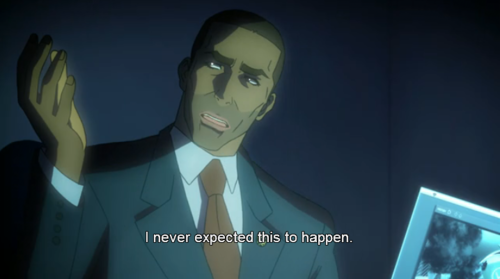
 One thing I find particularly weird is how much the mayor of Bild Stern resembles a cross between Barack Obama and Tom Dubois from The Boondocks. Not because anime characters that resemble real, famous people is unusual. I just didn't expect the personality of Bild Stern's mayor to be linked to a Barack Obama-esque image by Japanese animators. The mayor, quite simply, is a huge, indecisive coward who cares more about how the public will perceive the outcome of any decision than how it will actually effect the citizens of Bild Stern. I thought Barack Obama was perceived a lot more positively abroad. It's just a little strange but still pretty funny.
So far, no backstory episodes have been devoted to Sky High or Rock Bison. Rock Bison has been revealed to be one of Kotetsu's friends, a drinking buddy, and somebody who knows about his personal life. He is also one of Kotestu's strongest supporters to the other Heroes. Sky High's history will probably be revealed in one of the later episodes since he is the King of Heroes. Seeing what drives him and why he works so hard to be the best will most likely come out as the heroes are pushed to their very limits as the series wraps up and heroes (and main characters) are killed. But that's just my prediction on how things will go. It's based on watching many, many anime series. I wonder what the Vegas odds would say.
So far, I'm really enjoying Tiger & Bunny. It fits in somewhere between the very serious and heavy-handedness of Evangelion or dark like Gunslinger Girl and something much more light-hearted like Case Closed (aka Detective Conan). It's anime super-heroes, a genre I can't think of any other series belonging to. Though it borrows some tropes from other genres (like buddy cop), it still has a lot of anime tropes (ice queen, tomboy, power suits, mecha) and structure as well. I'm looking forward to what next Saturday's episode will bring.
Episode 14 is titled "Love is Blind."
[1] Apparently a VPN would allow me to deceive Hulu as well as network sites like CBS into thinking my IP address was American. I have not opted to do that even though I'm American and dagnabbit I have a right to watch these shows.
[2] Yes, I did just make an X-Men reference.
A word about the broadcast. It looks like Viz Media has a license to re-broadcast the show in the States right after it's shown in Japan. What that means, practically, is that most websites the newest episode of Tiger & Bunny available for streaming on Saturday with subtitles. It's an interesting experiment in bringing current anime to the rest of the world quickly. Tiger & Bunny, a show about the super heroes of Bild Stern who competed for points to be crowned King of Heroes, seems both an odd choice and yet timely, what with the huge popularity of movies based on American comic book licenses in recent years (Spider-Man, Batman, X-Men, Thor...)
FYI... there are tons of anime as well as movie and tv shows available to stream for free through youtube. Tiger & Bunny, however, is not one of them.
I've made it up to episode 14. If it's going to be a one season and done series, that means I'm just over half-way through (26 episodes total). But the show has just cleared it's first major story arc so now seems as good a time as any to revisit and review it.
Before, I said the team-up of Tiger and Bunny as the first NEXT crime-fighting duo presented elements of the buddy cop genre. That's not entirely true. Whereas the veteran cop is usually by the books and perhaps a little bit surly, both Wild Tiger (Kotetsu, the veteran) and his rookie parter Barnaby Brooks, Jr. (Bunny) have moments of the recklessness element that usually defines the rookie partner trope of this genre. Wild Tiger is generally reckless, always sticking his neck out to save people, which he sees as the one and only purpose of being a hero, disregarding the property damage he inflicts or the toes of his fellow heroes he may step on. Barnaby is more reserved, focused and the number two point getter behind King of Heroes Sky High as the next season of Hero TV progresses.
Barnaby can be set off, however, by his single-minded drive to hunt down the man who killed his parents. This drive is the reason he alone among the heroes has chosen to publicly reveal his face and identity to the public. He has taken his father's name so that when he finds the murdered, his father will symbolically be there extracting justice.
Barnaby witnessed the fiery murder of his parents when he was a child but cannot remember the face of the killer. However, the image of a tattoo has been seared into his memory. A super rich billionaire loner (Batman, anybody) with only his nanny to look after him (::kaff, kaff:: Alfred), Barnaby has taken it upon himself to sift through information to find a lead. A man with a similar tattoo turns up, revealing the name Ouroboros, which Barnaby takes to be the name of the organization behind his parents' murder.
Several episodes were devoted to exploring the backstories of some of the other heroes. For instance, in "Fear is Often Greater than the Danger," the beautiful ice queen Blue Rose decides to quit being a hero to pursue her desire to be a singer full time. She has been performing secretly out of costume in a lounge. But a lecture by Kotetsu brings her back to heroing and she swoops in at the last minute to save the heroes from an inferno.
In "Fire is a Good Servant but a Bad Master," Tiger and Bunny team-up with Fire Emblem to clear him of murder charges. Another NEXT has been killing criminals with fire powers that point to Fire Emblem. Fire Emblem is unique among the heroes not only because he doesn't have a corporate sponsor, he is actually the CEO of the company behind Fire Emblem, but he is openly and flamboyantly gay. Yes, the flamer character is flaming. But this doesn't seem to be mean-spirited, just the source of some rather silly humor. In a later episode when he is dispatched with Blue Rose and Dragon Kid to save the city, he talks about "girl power" and seems confused when Blue Rose responds that only two of them are girls.
Gay and ambiguously gendered characters are quite popular in anime and manga. No, I'm not just talking about the long-haired pretty boys, either. Because of the lack of religious sin and other cultural forces, homosexuality is not condemned like it is in the West. Notice I didn't say it's more accepted. But this topic is fodder for another entire blog post. If you're interested in the topic, let me know in the comments.
Investigating the fiery murders with Fire Emblem introduces the anti-hero Lunatic, a masked vigilante who shoots fiery bolts from a crossbow. He criticizes the justice delivered by the point-collecting stars of Hero TV. Certain hints seem to indicate that he is a certain long-haired judge Yuri Petrov seen hanging around the offices but as of episode 14, Lunatic's identity has not been positively revealed.
Lunatic figures into a few episodes as he murders various criminals, leading Barnaby, Kotetsu, and others to believe he works for Ouroboros and is eliminating loose ends, possibly people who could lead Barnaby to his parents' killer.
"There is Always a Next Time" delves into the past of Origami Cyclone, a sort of ninja-esque NEXT whose powers have never been shown. He is mostly known for just showing up in the background at most TV encounters and working very hard to make an appearance on Hero TV. Notably, he is the only NEXT to collect fewer points than Kotetsu.
Kotetsu, Barnaby, and the Origami Cyclone have been dispatched to a training academy for NEXT to prepare them to be the next generation of heroes of Bild Stern and the next generation of stars for Hero TV. When Kotetsu's class wants him to judge their abilities and let them know if they have what it takes to be heroes, he manages to politely encourage them even though most of them have powers more useless than Cypher, Skin, and Beak.[2] Origami Cyclone then asks Kotetsu to judge his power, which is the very Mystique-like power to copy appearances. Kotetsu encourages him by saying that he was chosen to become a Hero because there is something only he can do (starting to catch a theme yet).
In "Spare the Rod and Spoil the Child," the mayor of Bild Stern assigns Kotetsu the job of babysitting his child while he and his wife go out of the city. Even though Kotetsu has a daughter, Kaede, and thus has experience with children unlike any of the other heroes, the baby takes a liking to Dragon Kid, a tomboyish Chinese girl with lightning powers. Her parents sent her to Bild Stern to be a hero. The baby and Dragon Kid are kidnapped, and one of the kidnappers states that their parents (she mistakes the baby and Dragon Kid to be siblings) will pay a good ransom because they obviously love their children as revealed by what the flower on the baby's hat means. Dragon Kid takes this language of flowers idea home after she defeats the kidnappers and finds out the flower hair clip her parents gave her means "thinking about you." Going against her tomboyish nature, she finally decides to wear the pin, garnering a compliment from Kotetsu.
The next four episodes are the culmination of the plot. Barnaby finally remembers the face of his parents' killer and tracks him down to a prison in Bild Stern. Before I discuss those episodes, a few brief, overarching comments.
As unpopular with the public as he is, Kotetsu is the heart and soul of the Heroes. Barnaby and Blue Rose don't show him much respect and even Dragon Kid has some unkind things to say about his words and deeds sometimes. However, Rock Bison and Fire Emblem always stick up for him, often pointing out that what Kotetsu says isn't always exactly the truth because he is protecting somebody else or trying to do the right thing.
He is often the one with the right words of encouragement for the other heroes, serving as a mentor to them. He may not earn the points but he lends moral support and often the insight that allows the others to succeed.
And he's much brighter than almost everybody gives him credit for. It's his memory for faces that produces a lead in the Ouroboros subplot. And his ability to connect various bits of information to uncovers Jake Martinez's second power... Now, the close of the story arc.
The heart of Ouroboros leads to Jake Martinez, a mercenary currently in prison. Barnaby is on his way to see him when trouble breaks out in Bild Stern. This trouble also prevents Kotetsu from going home to see his daugher for the first time in an undisclosed length of time. He never takes vacation and every time he tries to make it home, a super-hero crisis happens. How inconvenient!
Mecha have appeared all over the city and starting blowing things up. The heroes are all called in to action and dispatched to various parts of the city to deal with multiple incursions. Kotetsu tells Barnaby to go ahead and go to the prison because he has been waiting his whole life for that confrontation.
The mecha attack, however, is just the opening move and a distraction from the real aim. Ouroboros villain Kriem has sent them out so that she can break her boyfriend Jake Martinez out of prison. Threatening to destroy the city if the mayor doesn't comply with her demands, Bild Stern releases Jake Martinez. The city complies but Origami Cyclone has used his shapeshifting powers to infiltrate the group as a human henchmen.
As villains as wont to do villainy, Jake backs out of the deal and threatens to destroy Bild Stern if the 7 heroes of Hero TV don't battle him in a one-on-one tournament. Origami Cyclone is discovered and injured. With his force field powers, Jake manages to defeat the King of Heroes Sky High, Rock Bison, and Kotetsu easily. Agnes, the producer of Hero TV, hatches a plot to delay the tournament by telling Jake they can get more viewers if he waits until the next day to fight Barnaby rather than doing it late at night. Jake agrees.
In reality, the ploy is meant to buy time so that signal jammers can be placed around the city to block Kriem's control over the stuffed animal bears that pilot the mecha. The next day, Barnaby fights Jake while Fire Emblem, Blue Rose, and Dragon Kid move into position to destroy the disabled mecha when the signal jammers are turned on.
Barnaby can't land a blow and Jake taunts him that it's because he has a second power, something unheard for NEXT. Kotetsu figures out that his power is reading minds and rushes out to tell Barnaby even though Kotetsu is severely injured. Meanwhile, the plot to disable the mecha doesn't work because they have auto-defense instructions and the three heroes have a difficult battle on their hands.
Kotetsu hatches a brilliant scheme that relies on deceiving Barnaby about the true nature of Jake's power so that Jake can't simply read his mind and avoid the attack. Barnaby believes Kotetsu and he manages to defeat the much more powerful Jake Martinez thank's to Kotetsu's plan. Kriem demands the heroes hand the defeated Jake over, believing she still holds the city hostage. In fact, Fire Emblem, Blue Rose, and Dragon Kid have defeated all the mecha.
Jake tries to escape but Kotetsu stops him. Trying to get free, Jake shoots down the helicopter Kriem is flying. She escapes, probably into Hero custody. However, it looks like the copter crashes on Jake. But I'm no sucker. I know how comic books go. Jake is not dead even though all indicators say otherwise. I fully expect him to figure into the endgame of this season or series. Maybe not as the major villain but somehow working for it. And Agnes will probably be involved somehow, too. But I'm starting to have second thoughts about her. She may have just been a red herring.
And that, briefly, is the first 14 episodes of Tiger & Bunny.


So far, no backstory episodes have been devoted to Sky High or Rock Bison. Rock Bison has been revealed to be one of Kotetsu's friends, a drinking buddy, and somebody who knows about his personal life. He is also one of Kotestu's strongest supporters to the other Heroes. Sky High's history will probably be revealed in one of the later episodes since he is the King of Heroes. Seeing what drives him and why he works so hard to be the best will most likely come out as the heroes are pushed to their very limits as the series wraps up and heroes (and main characters) are killed. But that's just my prediction on how things will go. It's based on watching many, many anime series. I wonder what the Vegas odds would say.
So far, I'm really enjoying Tiger & Bunny. It fits in somewhere between the very serious and heavy-handedness of Evangelion or dark like Gunslinger Girl and something much more light-hearted like Case Closed (aka Detective Conan). It's anime super-heroes, a genre I can't think of any other series belonging to. Though it borrows some tropes from other genres (like buddy cop), it still has a lot of anime tropes (ice queen, tomboy, power suits, mecha) and structure as well. I'm looking forward to what next Saturday's episode will bring.
Episode 14 is titled "Love is Blind."
[1] Apparently a VPN would allow me to deceive Hulu as well as network sites like CBS into thinking my IP address was American. I have not opted to do that even though I'm American and dagnabbit I have a right to watch these shows.
[2] Yes, I did just make an X-Men reference.
Thursday, May 5, 2011
13 assassins
SPOILER warning: Significant plot points are revealed. Read at your own peril.
Walking in to 13 Assassins this evening, I didn't know it was a remake of a 1963 black and white film of the same name directed by Eiichi Kudo. All I knew is that it was a samurai drama (jidaigeki) directed by Takashi Miike. The Miike name was enough to get me to the theater.
Miike is perhaps best known in the West for his disturbing "love story" film Audition and yakuza revenge piece Ichi the Killer. I've also seen Gozu and Dead or Alive 2. Based on these four films and things I've read about his rather lengthy filmography, I had certain expectations going into 13 Assassins. The fact that it didn't meet this expectations in no way is meant to denigrate the film.
13 Assassins is a movie about samurai, plain and simple. While that does mean guys cutting into each other with swords, samurai movies, at least Japanese samurai films, often revolve around a lot more (for instance, see: Twilight Samurai. But see: the 26 original Zatoichi films). Their is imperial politics, the relationship of retainer to lord (and ronin - masterless samurai), honor, family, and such; 13 Assassins pulls in all of these. But there's a good amount of hacking, slashing, bloodshed, and decapitation, too.
The plot, in brief, concerns the assassination of one Lord Naritsugu, son of the previous Shogun and brother to the current. He's a depraved noble, convinced that his birthright gives him not only the right but the duty to rape and murder those whose station in life is to serve him. With the announcement that he will ascend to the rank of Shogun's council and basically be the second-in-command of Japan, a plot is set in motion to make sure he never gets home to take that title. Under secret order from the Shogun, Shinzaemon, a veteran of the Shogun's guard, collects 12 other warriors to help him kill Naritsugu and his army of 200 men at the small town of Ochiai.
There are several of your basic warrior archetypes here. Just to name a few... Hirayama, Shinzaemon's pupil, is the swordsman of unmatched skill. He wields two blades in the final battle a la Miyamoto Musashi and is a general terror. Then there is Ogura, a youth full of devotion but who has never killed a man before. He takes his first life, is shaken by it, and receives reassurance from the more experienced samurai, transitioning him at last into their brotherhood of blood. Shinroukuro is Shinzaemon's nephew, a warrior disillusioned with samurai ways but brought back into the fold, and Sahara, a spear-wielding ronin who fights not for honor, ideals, or his master but demands payment up front to extinguish his debts, take care of his family, and to afford a brief taste of the luxuries he has never known. And then there's Koyata Kiga, a feral hunter released from a trap by the heroes while they are lost in the woods. He guides them back to the road and joins the 12 samurai in the final battle at Ochiai. Unlike them, he fights primarily with the very un-samurai weapon of rocks and slings, either tossing the rocks or using them as a makeshift flail.
 Miike's movies are known for the grotesque, surreal, and sometimes downright ridiculous. The torture scenes in Audition, Ichi's masochism, or pretty much the entirety of Gozu including the brutal murder of a small dog, a cow-headed woman lactating, a suit of human skin, and a woman giving birth to a fully grown man. 13 Assassins has precious little of that. The international version of the film, at 126 minutes, is 15 minutes shorter than the Japanese version. Perhaps Miike's signature shocking imagery and gore were cut either for time or sensitivities of foreign film-goers.
There were a few moments that seemed to show Miike's touch. For instance, one of Naritsugu's examples of cruelty was cutting the arms, legs, and tongue out of the daughter of the peasant who led a revolt against him. She is presented to Shinzaemon fully unclothed, writhing in her painful, pathetic state, to persuade him of the necessity to kill Naritsugu for his inhumanity. And while hiking through the wilderness, Kiga catches a big bug and sucks out its guts. Visually, it's depicted in quite a staid manner. Some members of the assassin's cadre are plague with leeches at one point, but this is mostly played for laughs rather than disgust or silliness.
The sword fights, where I expected to clearly see the hand of Miike at work, were relatively subdued and mild. Like the genre from which it springs, in 13 Assassins, most people are hit with the sword and then fall down to die. Limbs are not dismembered with explosive fountains of blood. Fingers are not chopped off in close up. Nobody gets stabbed through the eye in magnificent CGI glory. People are hit with the sword. They fall down. They die. That's pretty much it.
 There are three notable exceptions. First, in the first example of Naritsugu's cruelty, we seem him attack the young Uneme Makino from behind and repeatedly hack into him. Blood splatter Naritsugu's white kimono with every blow but we don't see the blade hit the body. Young master Makino, a newlywed, had come to investigate why his wife Chise was delayed. Naritsugu had earlier dragged her by her hair across the floor into his room and raped her. The elder Makino, Uneme's father, relates this personal grievance against Naritsugu to Shinzaemon first before revealing the horribly disfigured to elicit the veteran's cooperation.
Second, during the first encounter between the assassins and a band of ronin paid by Naritsugu's retainer Hanbei, Ogura's sword gets stuck in a man after he cuts deeply into his shoulder. Ogura struggles to free his blade while the man attempts to strike him with a short sword. But the gore isn't played up here and it's not meant to be over the top, at least in the international cut.
Third, when Shinzaemon finally faces down his old rival Hanbei at the end of the film, he decapitates the man after admonishing him that they had been equals in skill in the dojo, implying that when the civility of the dojo is gone and it's life or death, Hanbei had always been outmatched. It wasn't just lucky breaks that moved Shinzaemon ahead, as Hanbei alleges, but a real difference in the character of the men. Hanbei's head comes off, but not on screen. We do not see the sword cut through his neck or blood spurt from the wound. Instead, we see the head fly from off screen onto the ground with an absence of arterial blood spray.
 With his final guard defeated, Naritsugu is left to take on the hardened warrior Shinzaemon. Naritsugu kicks the head of his faithful retainer. But this isn't for laughs like the CGI cockfight in DOA2. It's a final example of the utterly malevolent heart of the Lord. Shinzaemon prevails and decapitates his foe but again without a lot of red-dyed corn syrup.
(NOTE: I had to take a bathroom break during the final battle in Ochiai right after Hirayama and Ogura die. I suppose there may have been Miike-type ultra-violence during that 4 minutes I missed.)
All of the assassins save Shinroukuro and Kiga are dead at the close of battle at Ochiai. Kiga runs off to try to woo his beloved Upashi, wife of his boss and the reason he was originally caught in the trap. Shinroukuro, encouraged by his uncle in his dying breath to lay aside samurai ways and do what he wants, considers becoming Japan's greatest bandit or perhaps sailing to America and sleeping with lots of (white) women. The two part ways headed in opposite ways through the bloody, burning carnage of the small town.
Comparisons to The Seven Samurai and The Magnificent Seven are ready. But there's also a more recent American movie that explores similar themes: 300. A charismatic leader, a small band of hardened warriors fighting against an impossibly large odds, swords, a depraved and decadent enemy leader. Both 300 and 13 Assassins are based on supposedly actual historical events. But in 300 the heroes go out stop the enemy from invading their home, therefore assuming a defensive role, the 13 assassins are sent out on a mission to kill Lord Naritsugu. And 13 Assassins obviously hews much more closely to reality than the over the top cinematic action of 300.
One flaw in the movie, one that 15 minutes of cut footage probably wouldn't remedy, is the large number of heroes, for the most part, don't really stand out as individuals. Unlike another recent American movie, Lord of the Rings (or the dwarves that press Bilbo into service in The Hobbit), it's difficult to keep many of the 13 assassins apart. They are initially introduced and then, besides a single-dimension portrait (the comic relief guy, the demolition guys, and others that don't even stand out), they're all guys in dark clothes with swords. But this a criticism that gets leveled a lot of films. Video games, too. The Ocean's 11 remake did a good job of crafting a unique identity for each of the almost as large cast of role-players.
13 Assassins is a great film but it's very much a period piece following the conventions of the genre. It starts out slow, establishing the intricacy of politics, personal relations, and depravity that launch Shinzaemon and his followers on the road to Ochiai. The second third has a little more action as the heroes take to the road, have a limited confrontation, and begin putting their plan into effect to force Naritsugu and his army to Ochiai. The third and final act sees the heroes fortify Ochiai before the epic battle of 13 against 200 unfolds in all its violent, explosive, moving walls, sword swinging glory. No buckets of blood or flying limbs but 13 Assassins is a thoroughly enjoyable, dramatic tale of honor and duty in pre-Meiji Japan.
UPDATE 30 May 2011: You can now pre-order 13 Assassins on DVD or Blu-ray
 .
.
Buy stuff online? Why not join ebates and get cashback with every purchase. Search for things on the internet? Bing rewards you for every search and lets you earn gift cards and other rewards. Click on the buttons below to join.


Walking in to 13 Assassins this evening, I didn't know it was a remake of a 1963 black and white film of the same name directed by Eiichi Kudo. All I knew is that it was a samurai drama (jidaigeki) directed by Takashi Miike. The Miike name was enough to get me to the theater.
Miike is perhaps best known in the West for his disturbing "love story" film Audition and yakuza revenge piece Ichi the Killer. I've also seen Gozu and Dead or Alive 2. Based on these four films and things I've read about his rather lengthy filmography, I had certain expectations going into 13 Assassins. The fact that it didn't meet this expectations in no way is meant to denigrate the film.
13 Assassins is a movie about samurai, plain and simple. While that does mean guys cutting into each other with swords, samurai movies, at least Japanese samurai films, often revolve around a lot more (for instance, see: Twilight Samurai. But see: the 26 original Zatoichi films). Their is imperial politics, the relationship of retainer to lord (and ronin - masterless samurai), honor, family, and such; 13 Assassins pulls in all of these. But there's a good amount of hacking, slashing, bloodshed, and decapitation, too.
The plot, in brief, concerns the assassination of one Lord Naritsugu, son of the previous Shogun and brother to the current. He's a depraved noble, convinced that his birthright gives him not only the right but the duty to rape and murder those whose station in life is to serve him. With the announcement that he will ascend to the rank of Shogun's council and basically be the second-in-command of Japan, a plot is set in motion to make sure he never gets home to take that title. Under secret order from the Shogun, Shinzaemon, a veteran of the Shogun's guard, collects 12 other warriors to help him kill Naritsugu and his army of 200 men at the small town of Ochiai.
There are several of your basic warrior archetypes here. Just to name a few... Hirayama, Shinzaemon's pupil, is the swordsman of unmatched skill. He wields two blades in the final battle a la Miyamoto Musashi and is a general terror. Then there is Ogura, a youth full of devotion but who has never killed a man before. He takes his first life, is shaken by it, and receives reassurance from the more experienced samurai, transitioning him at last into their brotherhood of blood. Shinroukuro is Shinzaemon's nephew, a warrior disillusioned with samurai ways but brought back into the fold, and Sahara, a spear-wielding ronin who fights not for honor, ideals, or his master but demands payment up front to extinguish his debts, take care of his family, and to afford a brief taste of the luxuries he has never known. And then there's Koyata Kiga, a feral hunter released from a trap by the heroes while they are lost in the woods. He guides them back to the road and joins the 12 samurai in the final battle at Ochiai. Unlike them, he fights primarily with the very un-samurai weapon of rocks and slings, either tossing the rocks or using them as a makeshift flail.

There were a few moments that seemed to show Miike's touch. For instance, one of Naritsugu's examples of cruelty was cutting the arms, legs, and tongue out of the daughter of the peasant who led a revolt against him. She is presented to Shinzaemon fully unclothed, writhing in her painful, pathetic state, to persuade him of the necessity to kill Naritsugu for his inhumanity. And while hiking through the wilderness, Kiga catches a big bug and sucks out its guts. Visually, it's depicted in quite a staid manner. Some members of the assassin's cadre are plague with leeches at one point, but this is mostly played for laughs rather than disgust or silliness.
The sword fights, where I expected to clearly see the hand of Miike at work, were relatively subdued and mild. Like the genre from which it springs, in 13 Assassins, most people are hit with the sword and then fall down to die. Limbs are not dismembered with explosive fountains of blood. Fingers are not chopped off in close up. Nobody gets stabbed through the eye in magnificent CGI glory. People are hit with the sword. They fall down. They die. That's pretty much it.

Second, during the first encounter between the assassins and a band of ronin paid by Naritsugu's retainer Hanbei, Ogura's sword gets stuck in a man after he cuts deeply into his shoulder. Ogura struggles to free his blade while the man attempts to strike him with a short sword. But the gore isn't played up here and it's not meant to be over the top, at least in the international cut.
Third, when Shinzaemon finally faces down his old rival Hanbei at the end of the film, he decapitates the man after admonishing him that they had been equals in skill in the dojo, implying that when the civility of the dojo is gone and it's life or death, Hanbei had always been outmatched. It wasn't just lucky breaks that moved Shinzaemon ahead, as Hanbei alleges, but a real difference in the character of the men. Hanbei's head comes off, but not on screen. We do not see the sword cut through his neck or blood spurt from the wound. Instead, we see the head fly from off screen onto the ground with an absence of arterial blood spray.

(NOTE: I had to take a bathroom break during the final battle in Ochiai right after Hirayama and Ogura die. I suppose there may have been Miike-type ultra-violence during that 4 minutes I missed.)
All of the assassins save Shinroukuro and Kiga are dead at the close of battle at Ochiai. Kiga runs off to try to woo his beloved Upashi, wife of his boss and the reason he was originally caught in the trap. Shinroukuro, encouraged by his uncle in his dying breath to lay aside samurai ways and do what he wants, considers becoming Japan's greatest bandit or perhaps sailing to America and sleeping with lots of (white) women. The two part ways headed in opposite ways through the bloody, burning carnage of the small town.
Comparisons to The Seven Samurai and The Magnificent Seven are ready. But there's also a more recent American movie that explores similar themes: 300. A charismatic leader, a small band of hardened warriors fighting against an impossibly large odds, swords, a depraved and decadent enemy leader. Both 300 and 13 Assassins are based on supposedly actual historical events. But in 300 the heroes go out stop the enemy from invading their home, therefore assuming a defensive role, the 13 assassins are sent out on a mission to kill Lord Naritsugu. And 13 Assassins obviously hews much more closely to reality than the over the top cinematic action of 300.
One flaw in the movie, one that 15 minutes of cut footage probably wouldn't remedy, is the large number of heroes, for the most part, don't really stand out as individuals. Unlike another recent American movie, Lord of the Rings (or the dwarves that press Bilbo into service in The Hobbit), it's difficult to keep many of the 13 assassins apart. They are initially introduced and then, besides a single-dimension portrait (the comic relief guy, the demolition guys, and others that don't even stand out), they're all guys in dark clothes with swords. But this a criticism that gets leveled a lot of films. Video games, too. The Ocean's 11 remake did a good job of crafting a unique identity for each of the almost as large cast of role-players.
13 Assassins is a great film but it's very much a period piece following the conventions of the genre. It starts out slow, establishing the intricacy of politics, personal relations, and depravity that launch Shinzaemon and his followers on the road to Ochiai. The second third has a little more action as the heroes take to the road, have a limited confrontation, and begin putting their plan into effect to force Naritsugu and his army to Ochiai. The third and final act sees the heroes fortify Ochiai before the epic battle of 13 against 200 unfolds in all its violent, explosive, moving walls, sword swinging glory. No buckets of blood or flying limbs but 13 Assassins is a thoroughly enjoyable, dramatic tale of honor and duty in pre-Meiji Japan.
UPDATE 30 May 2011: You can now pre-order 13 Assassins on DVD
or Blu-ray
.
Buy stuff online? Why not join ebates and get cashback with every purchase. Search for things on the internet? Bing rewards you for every search and lets you earn gift cards and other rewards. Click on the buttons below to join.
Saturday, March 26, 2011
disasters haven't dampened japan's predilection for the weird
I'm not gonna lie. I love Japan. You might even say I'm a Japanophile. But I also hate disaster porn. Ever since 9/11 the American media has fallen in love with the gratuitous, the spectacle of tragedy. 24/7 cable news coverage thrives on the continuous "coverage" by manufacturing the unfolding of an "event." But enough meta-media commentary...
I've been more interested in the trickles of information that have come through showing how Japan is coping in the wake of the quake, tsunami, nuclear reactor trifecta. Instead of a rolling counter of dead bodies and CGI effects projecting worse case scenarios, Japan (not just the government but the nation) has rallied to overcome. Western news agencies have taken the opportunity to emphasis the exotic other-ness of Japan: look how orderly they line up to buy food, gas, etc.; there is no looting in Tokyo.
Here's some interesting bits you may not have heard.
Immediately after the quake and tsunami, the Yakuza opened up their dormitories to the public, making sure people had a safe place to sleep. They were shipping in food by the ton to make sure people were fed. They even helped keep order on the street where Japanese police weren't able to maintain their normal omni-presence.
Too often, we don't really think about how scary it must be for young children caught in such disasters. Japan didn't forget. In the aftermath, Japan's super heroes began tweeting encouraging messages to their young followers. You think twitter is lame. I think it may have helped keep up the flagging spirits of an entire generation.
How do you explain what's going on with the damaged nuclear reactors to a young child? With a cartoon about farts and poo. One thing I'd like to point out that just because something is animated doesn't mean it's childish. In Japan, cutesy, cartoon mascots explain everything from quarantine procedures at the airport to the weather report. The strict segregation of childish from adult in cartoons, comics, and cute mascots prevalent in America and much of the world doesn't prevail in Japan. Enjoy this cartoon. And let's hope Nuclear Boy doesn't poo in the classroom.
I've been more interested in the trickles of information that have come through showing how Japan is coping in the wake of the quake, tsunami, nuclear reactor trifecta. Instead of a rolling counter of dead bodies and CGI effects projecting worse case scenarios, Japan (not just the government but the nation) has rallied to overcome. Western news agencies have taken the opportunity to emphasis the exotic other-ness of Japan: look how orderly they line up to buy food, gas, etc.; there is no looting in Tokyo.
Here's some interesting bits you may not have heard.
Immediately after the quake and tsunami, the Yakuza opened up their dormitories to the public, making sure people had a safe place to sleep. They were shipping in food by the ton to make sure people were fed. They even helped keep order on the street where Japanese police weren't able to maintain their normal omni-presence.
Too often, we don't really think about how scary it must be for young children caught in such disasters. Japan didn't forget. In the aftermath, Japan's super heroes began tweeting encouraging messages to their young followers. You think twitter is lame. I think it may have helped keep up the flagging spirits of an entire generation.
How do you explain what's going on with the damaged nuclear reactors to a young child? With a cartoon about farts and poo. One thing I'd like to point out that just because something is animated doesn't mean it's childish. In Japan, cutesy, cartoon mascots explain everything from quarantine procedures at the airport to the weather report. The strict segregation of childish from adult in cartoons, comics, and cute mascots prevalent in America and much of the world doesn't prevail in Japan. Enjoy this cartoon. And let's hope Nuclear Boy doesn't poo in the classroom.
Monday, March 21, 2011
i guess they think everybody from texas is in the militia...
I, like most Americans, receive a lot of junk email and spam. Apparently my sex organ is too small and fails to reach satisfactory tumescence on demand. Also, apparently, I should be worried about increasing the size of my breasts as an Asian woman to please my male partner (disclosure: I am a white guy). Thankfully these things, as well as ads for a cocktail of painkillers without prescription, are intercepted by my provider's spam filters. But one piece of mail keeps getting through.
Back in the day, I think I registered to vote as Republican. However, I'm almost entirely sure I've never voted that way in an election. But I still get emails from Texas Republicans urging me to vote and participate in activities that I find, frankly, politically and morally repugnant. I don't know why I don't just unsubscribe. Perhaps like the folks of J.G. Ballard's _Crash_, I get off looking at human tragedy. Seriously, Rick Perry, secession?
But there's another email I receive regularly; it comes from the Ready Nation. I have no hypothesis how I ended up on their mailing list except for the aforementioned Texas Republican party link. This "business" markets your typical survivalist mentality gear to people (MREs and long term storage foodstuffs, emergency preparedness kits, etc.) This evening I received a disturbing email playing off the tragedy in Japan to sell me through their Ready Store a variety of Saratoga Farms canned foodstuffs by the case [10 cans per] (diced apples, green beans, macaroni, freeze-dried scrambled eggs, even buttermilk biscuits cuz they know how us southerners love a healthy dose of biscuits and gravy before we venture out of the Vault to battle giant radioactive scorpions in search of a replacement Water Chip).
Scared of the tsunami and earthquake (the newsletter still rated it 8.9 instead of the upgraded 9.0)? Nuclear crisis emptied shelves of food in Tokyo. Buy our cases so you don't get caught unprepared when God's divine wrath via natural disasters strikes in your area. Way to exploit a human tragedy to sell a few more cans of freeze-dried beans, Ready Nation. Wanna also sell me some fake potassium iodide pills to stave off radiation poisoning? Sheesh.
Back in the day, I think I registered to vote as Republican. However, I'm almost entirely sure I've never voted that way in an election. But I still get emails from Texas Republicans urging me to vote and participate in activities that I find, frankly, politically and morally repugnant. I don't know why I don't just unsubscribe. Perhaps like the folks of J.G. Ballard's _Crash_, I get off looking at human tragedy. Seriously, Rick Perry, secession?
But there's another email I receive regularly; it comes from the Ready Nation. I have no hypothesis how I ended up on their mailing list except for the aforementioned Texas Republican party link. This "business" markets your typical survivalist mentality gear to people (MREs and long term storage foodstuffs, emergency preparedness kits, etc.) This evening I received a disturbing email playing off the tragedy in Japan to sell me through their Ready Store a variety of Saratoga Farms canned foodstuffs by the case [10 cans per] (diced apples, green beans, macaroni, freeze-dried scrambled eggs, even buttermilk biscuits cuz they know how us southerners love a healthy dose of biscuits and gravy before we venture out of the Vault to battle giant radioactive scorpions in search of a replacement Water Chip).
Scared of the tsunami and earthquake (the newsletter still rated it 8.9 instead of the upgraded 9.0)? Nuclear crisis emptied shelves of food in Tokyo. Buy our cases so you don't get caught unprepared when God's divine wrath via natural disasters strikes in your area. Way to exploit a human tragedy to sell a few more cans of freeze-dried beans, Ready Nation. Wanna also sell me some fake potassium iodide pills to stave off radiation poisoning? Sheesh.
Friday, March 26, 2010
The Crisis of Modern Masculinity
Ok, that titles a little too broad for the scope of a single blog entry but the questions sits at the crux of a lot of my thinking since about 1999. What does it mean to be a good guy these days? Must he always finish last? What's so great about bad boys if all they do is break your heart? And why do you then run to your gay best friend for support but you refuse to date the hetero version of him?
50% of the world's population seemingly breaks down into one of three categories:
alpha - the dominant and domineering personality, callous, self-interested, in control, successful, aggressive competitive
beta - the alpha's subordinate, inferiority complex, just trying to get by, conflict-avoidant
omega - checked out of the system, the failure or never even tried, arrested development
The online magazine slate.com recently ran an article classifying the various sub-species of omega males through an analysis of Greenberg, the oeuvre of Judd Apatow, and basically any role featuring Jason Schwartzman.
http://www.slate.com/id/2248156/
The thrust of the article? Take a look at the title: women hate omega males. Or at least we are supposed to believe. Das man has pronounced it into the echo chamber of the idle talk engine.
lemondrop.com continues this assault on the unrugged alpha male in its review of the book Undateable (if you're interested in it, google it).
http://www.lemondrop.com/2010/03/17/what-makes-a-guy-undateable/7
Wow. Who the heck meets those criteria and the other 318 not mentioned in the article. Perhaps the Brawny Man? I'm pretty sure he doesn't eat salads or wear dress shoes. He also happens to be an advertising fiction but who's counting when we can pile on about all the superficial things we don't like about men.
And then there's this article published by researchers at my alma mater. The take away is that a working mom's self-esteem can take a significant hit when her hubby also does a bang-up job of taking care of baby. But, wait, don't you always complain that he's not... but when he does and he doesn't screw it up you feel... aaaaarrrrrgggghhhhh!
What's a guy to do? Ladies (supposedly) want a bruting alpha. But an alpha doesn't love you, he only loves himself. He's going to break your heart one way (sleeping with your best friend) or another (he just doesn't give a damn about you). So can you go beta? NO! Dress nice? Show some empathy? Be supportive? Who wants to date a wuss? Danger is what we crave. Danger hurts and so it's exciting. The Sword of Damocles is dangling, when will it all come crashing down?
Cro-mag or metro... You sleep with one but you hate him, you love the other but won't invite him into the bedroom.
And thus every man is faced with a choice: alpha or beta? Winner or loser? Is it any wonder in Japan guys are beginning to check out of the game? They're called grass eating men (they even denigrate salad eaters in Asia). For a country experiencing a population crunch, they are a crisis.
http://www.slate.com/id/2220535/
What's a modern man to be? Alpha, beta, or omega?
50% of the world's population seemingly breaks down into one of three categories:
alpha - the dominant and domineering personality, callous, self-interested, in control, successful, aggressive competitive
beta - the alpha's subordinate, inferiority complex, just trying to get by, conflict-avoidant
omega - checked out of the system, the failure or never even tried, arrested development
The online magazine slate.com recently ran an article classifying the various sub-species of omega males through an analysis of Greenberg, the oeuvre of Judd Apatow, and basically any role featuring Jason Schwartzman.
http://www.slate.com/id/2248156/
The thrust of the article? Take a look at the title: women hate omega males. Or at least we are supposed to believe. Das man has pronounced it into the echo chamber of the idle talk engine.
lemondrop.com continues this assault on the unrugged alpha male in its review of the book Undateable (if you're interested in it, google it).
http://www.lemondrop.com/2010/03/17/what-makes-a-guy-undateable/7
Wow. Who the heck meets those criteria and the other 318 not mentioned in the article. Perhaps the Brawny Man? I'm pretty sure he doesn't eat salads or wear dress shoes. He also happens to be an advertising fiction but who's counting when we can pile on about all the superficial things we don't like about men.
And then there's this article published by researchers at my alma mater. The take away is that a working mom's self-esteem can take a significant hit when her hubby also does a bang-up job of taking care of baby. But, wait, don't you always complain that he's not... but when he does and he doesn't screw it up you feel... aaaaarrrrrgggghhhhh!
What's a guy to do? Ladies (supposedly) want a bruting alpha. But an alpha doesn't love you, he only loves himself. He's going to break your heart one way (sleeping with your best friend) or another (he just doesn't give a damn about you). So can you go beta? NO! Dress nice? Show some empathy? Be supportive? Who wants to date a wuss? Danger is what we crave. Danger hurts and so it's exciting. The Sword of Damocles is dangling, when will it all come crashing down?
Cro-mag or metro... You sleep with one but you hate him, you love the other but won't invite him into the bedroom.
And thus every man is faced with a choice: alpha or beta? Winner or loser? Is it any wonder in Japan guys are beginning to check out of the game? They're called grass eating men (they even denigrate salad eaters in Asia). For a country experiencing a population crunch, they are a crisis.
http://www.slate.com/id/2220535/
What's a modern man to be? Alpha, beta, or omega?
Subscribe to:
Posts (Atom)