Director: Yasuharu Hasebe
Starring: Tamaki Katsura, Yutaka Hayashi
Assault! Jack the Ripper is a Japanese horror film from Nikkatsu studios in their Violent Pink line. Pink films (also called "eroduction" or "Roman porno") are a genre of Japanese films that has no exact analog in the West.[1] Per studio guidelines, pink films contain a certain quota of sex scenes spaced at required intervals, making them similar to the softcore porn of Cinemax and Showtime ilk. But the stories are generally more complex and subtly psychological and quite often feature nuanced female characters unlike softcore porn.
Violent Pink (also called Pinky Violence) is a subgenre of Pink that involves violence, very often graphic in nature.
Much ink has been spilt breaking down the Western horror genre, including exploration of the representation of gender in horror. I'm intentionally not going to approach Assault! Jack the Ripper from that angle because of differences not only between American and Japanese culture but also because of the differences in the history of cinema and visual language in the two countries. Although a discussion of the abject or the targeting by the killer of sexually active women in horror films could potentially be fruitful in this case, I leave them aside. I will instead just discuss two major themes in the movie.
Wikipedia summarizes the plot of Assault! Jack the Ripper as: "A young couple engage in a rampage of murder, rape and mayhem in order to stimulate their sexual appetites." Succinct, it fails to describe the two major themes of the story. First, the victims are increasingly targeted as women as such. Second, the sexual charge that initially propels the murder spree eventually transforms into the eroticization of violence itself for the Cake Man (the male lead).
The film begins with Afro Perm[2] (the female lead) goads the Cake Man into driving her home in a rainstorm from the restaurant where they both work. They stop to pick up a female Hitchhiker who seems to be garbed in hospital clothing. The Hitchhiker stabs herself in the arm with a cake knife, horrifying the Cake Man and Afro Perm, and then reveals a collection of razor blades she intends to use to continue her self-mutilation. She is likely an escaped mental patient.
The Cake Man ejects her from the car but she won't let go as he speeds away. Eventually, she falls and dies. Scared because of their role in her death, Cake Man and Afro Perm drag the Hitchhiker's body into an old scrap yard. Afro Perm strips the Hitchhiker's body for some reason and ditches her clothes. Cake Man then drags her body deeper into the junk yard. Unfortunately, her corpse snags at the crotch on a bit of metal and the Cake Man tears the Hitchhiker in half.
Back at Afro Perm's apartment, the pair deal with the unintentional killing with varying levels of ease. The Cake Man is shaken and disturbed while Afro Perm seems nonplussed. She strips out of her wet clothes, revealing a plump body that's quite a bit curvier in the bosom and bottom than most of the rest of the women in this movie. Eventually, Cake Man and Afro Perm cap off the night with some very intense and passionate sex.
The next day, Afro Perm approaches Cake Man at work but he ignores her. To make him pay attention, Afro Perm leaves with a male customer whose lecherous advances she had spurned yesterday. Cake Man follows the pair and watches as they perform oral sex on each other inside the car. Having made her point and firmly seizing Cake Man's attention, Afro Perm gets out of the car and walks over to Cake Man's car fully naked.
The duo try to have sex again back at her place but it's just missing a certain spark. That spark, they decide, is murder. And so begins a killing spree initially driven by the couple's libido.
The pair first stalk a high school girl who had previously come into the restaurant. They hit her with their car and then quickly snatch her up. Instead of an abandoned junk yard, this time they take their victim, still very much alive, to an abandoned bowling alley. Afro Perm is committed to the murder right off but Cake Man has reservations. All hesitation is shed, however, when the young girl slips her gag and begins to scream. Cake Man charges her with a knife, the same knife that the Hitchhiker had used to cut her arms. He stabs her but we cannot see where the knife pierces her body because of the framing of the shot. We only know that it hits somewhere below her chest.
The couple go at it hot and heavy on a nearby bench. Murder is just the aphrodisiac their sex life needs. But while Afro Perm rides him, Cake Man stares at the bleeding body of the young girl. Once they have finished up, the couple ditch the body in an elevator shaft.
Their next target is the girlfriend of the restaurant patron Afro Perm messed around with. They follow the pair to the airport, and after the man boards his flight to America, the couple abducts the woman and takes her to a graveyard. The woman pleads with Afro Perm as a woman to spare her life. Afro Perm orders her to perform oral sex on Cake Man, which she does. Then Afro Perm commands Cake Man to perform oral sex on the woman. He lies down on the ground and she lies on top of him. She continues to perform. He, on the other hand, brutally stabs her in the groin using the same knife as before. The couple then hides the woman's body beneath a grave stone before having sex in the car.
This scene is pivotal to the film in three ways. First, it's the first explicit scene of the Cake Man's m.o.; we have the reuse of the knife and also his preferred target: the groin. Remember, he accidentally tore the Hitchhiker apart at the groin in the junk yard. We can also speculate that he stabbed the high school girl in the groin, too, even though the camera wasn't positioned for us to see it. Second, it is the zenith of the conjunction between sexual intercourse and violence. Not only do the couple have sex after the killing, but the killing itself involves rape of the victim. As the killings continue, we see a growing divorce between explicit sexual satisfaction and the act of murder as the stabbings themselves look increasingly sexual. Third, post-coitus, Afro Perm says to Cake Man "We're just like a husband and wife. I'm going to look after you. Like a real wife." The couple take up residence at Afro Perm's apartment. She attempts to move their relationship into the domestic sphere, cooking and cleaning for Cake Man. She even refers to their relationship as a "marriage" of sorts. But as we will see, Cake Man's intentions become very different.
Cake Man's next kill comes without Afro Perm. It is also the first stranger; someone that the couple is not connected to. He leaves their apartment to go wandering around a downtown area at night. While walking, Cake Man finds an invitation to a prostitute's place of work. The prostitute appears to be an older woman, probably in her late 30s or early 40s, likely older than any of the victims so far and also Afro Perm. She strips and dangles her breasts in Cake Man's face but he lies perfectly still, seemingly uninterested. Suddenly, he flips her over, pins her to the bed, and may or may not have sex with her. We do not see him remove his underwear but she does moan.
Cake Man gets up, puts on his pants, and retrieves the knife he's used in the other killings. The prostitute thinks that he just wants to play a little rough and offers to let him tie her up for a little more money. Instead, Cake Man stabs her in the hand. He then drags her into the bathroom where he binds her hands with the shower line before stabbing her fatally in the groin. We also see him drive the knife upwards, attempting to cut her in half. This splitting action is much more explicit than the previous kill. The camera zooms in on the knife and follows it as he forces it from the groin to the stomach, lingering on the action. When he returns home, he sharpens the knife. He does not have sex with Afro Perm.
At this point, while the murders are still tied explicitly to sexual satisfaction for Cake Man, we see that his appetite for murder and sexual satisfaction have been segregated from Afro Perm. She initially urged him into the murder for turn-on game but now he doesn't need her to (1) pick the targets, (2) goad him to kill, (3) have sex with post-kill. However, with the nudity and touching of the prostitute, he still links the act of murder and sex.
The next kill, however, does not contain any explicit sexual overtones. Cake Man targets a young mother who he encountered earlier in the alley outside the restaurant with her child. She works at a wedding reception hall. He goes to her work and asks her to speak in the garden. There, he stabs her in her ceremonial clothing. He stabs her in the groin and then lifts, again attempting to cut his victim in half. He has to flee before he can finish the job but we are shown a still shot of her body lying on the ground, a bloody mess staining her white clothes over her groin area.
The film next cuts to Cake Man and Afro Perm entering her apartment. News of his attack plays on the television and she confronts him, accusing him of "cheating" on her by killing without her. She also mentions that it's been 10 days since they have last had sex, confirming that Cake Man didn't sleep with her after killing the prostitute. Afro Perm demands that he take her with him but he strikes her and then leaves the apartment.
Cake Man attacks a woman working alone at night across the street in a dress shop. Neither Cake Man nor Afro Perm have been shown to have any interaction with her; she is his second stranger kill. It also seems to be the first time he has set out with the purpose of killing a stranger. Initially, she is about to escape but Perm Girl enters to help him. Cake Man then starts slashing the dress maker with the knife, cutting her across the back and several times on her breasts. They struggle over the knife and the blade cuts into her hand as Cake Man forces it lower down her body. He spins her around and stabs the knife into her groin. Her head tosses back in imitation of the moment of penetration in sexual intercourse before he lets her fall to the ground. Cake Man then flees, leaving her body there. Afro Perm follows him.
These two kills sever completely the connection between explicit sexual intercourse and Cake Man's desire for murder. However, the murders themselves have taken on more overt sexual characteristics. The mother is shown with red blood staining the white clothes directly over her groin after he stabs her from his own groin area. The dressmaker's positioning with Cake Man and her body language both imitate sexual intercourse at the moment the knife pierces her groin. Rather than his penis entering Afro Perm's body to metonymically repeat the fatal stabbings that are his m.o., the murder and the sex have now collapsed into a single act.
At this point in the film, with barely 8 minutes left, the director introduces a new element: food. After murdering the dressmaker, the film cuts back to Afro Perm's apartment. Cake Man spoons overly generous amounts of jelly into his croissant, which has been split along the edge and spread open in such a way as to resemble a vulva.[3] While he eats, Afro Perm performs oral sex on him but Cake Man doesn't seem to be paying attention. Afro Perm suggests they go on a picnic on their next day off.
Cut to the graveyard (yes, the same graveyard where they earlier raped, murdered, and stashed the body of a victim). Afro Perm performs oral sex on Cake Man while he lies on his back eating. She then strips and mounts him while he continues to eat, seemingly unmoved by her actions. He continues to eat while she moans, proclaims how happy she is, and tells him never to leave her.
I'm not quite sure what this conjunction of food and sex with Cake Man being distant is supposed to mean. Does his eating of the food Afro Perm prepares and thoroughly un-passionate reaction to sex represent the domestic sphere and his resistance to settling down? Or does his gluttonous consumption reveal that now he is out of control (i.e. can't sate his appetite for food or murder)? Is the pairing of food and un-emotional sex supposed to contrast with the earlier pairing of murder and passionate sex? If so, to what end?
After the picnic, we cut back to the apartment where Afro Perm is doing laundry while Cake Man sits at the table drinking a coke. But then Cake Man slips out to stalk a nurse on her way home from work. He shoves her into a dorm room where three other women are getting ready for bed. He stabs the first in the chest and the next one in the groin before tying the third standing with her arms over her head to the bed. The camera pans to a shot of a woman on the ground with her legs open towards the camera, focused on her white underwear. He stabs this woman, the first roommate, in the groin and smears her blood on the nurse's face with the knife. Next, he cuts along the bound woman's chest beneath her breasts, slashes her throat, then cuts an X on her chest before stabbing her in the groin. When the nurse screams, he lashes out at her with the knife, cutting an X across her chest and then horizontally and vertically.
This final murder scene of four strangers includes several face close-ups of the women with expressions that hover somewhere between fear and ecstasy. Their gasps at times sound like sexual moans. This ambivalence reinforces the transition that has happened between the overt and subterranean sexual pleasures of killing for the Cake Man.
As he is leaving, Afro Perm shows up. She clutches him and calls him "husband" as he stabs her. She falls to the floor and the camera zooms on her face and rotates as blood pools beneath her head. Cake Man is then shown in silhouette walking against the morning sky along a spillover. He takes off his shirt, washes the knife in the water, and then examines it as he continues walking along.
The end.
Although Cake Man is at first a reluctant murderer, his constant m.o. of stabbing women in the groin, supplemented by slashing at their breasts, betrays an underlying sexual element of the crimes even without the post-killing intercourse with Afro Perm. Possession of sexual knowledge does not seem to motivate the murders as the high school girl is presumptively "innocent" and there is no indication that the nurses are impure either. Given the attack on the young mother who worked at the wedding hall, it doesn't necessarily seem to be "motivated" to restore a more traditional social order.
Over time, the sex that initially motivated the murders becomes folded into the act of murdering itself. Cake Man and Afro Perm began their murder spree in order to spark the flames of passionate sex. They would kill, they would have sex. Sexual play with the victims was also included. They had sex in the presence of the body of the teenage girl. The restaurant patron's girlfriend was made to perform oral sex on Cake Man. There is sexual touching with the third victim, the prostitute, even if there was no sexual intercourse. But as sexual activity during or after the murders ceases, the murders themselves come to look more and more like intercourse.
Taken together, what do these two themes mean? I'm still trying to work that out. Any guesses?
[1] You can read up on Pink films here.
[2] Really, you have to see it. According to Wikipedia, the director asked Tamaki Katsura to style her hair in this way for the film.
[3] The jelly he is spooning into the croissant may be red but I can't tell. I'm colorblind. If so, that image would repeat the imagery of the bloody woman's parts Cake Man has been carving.
Showing posts with label movies. Show all posts
Showing posts with label movies. Show all posts
Sunday, July 15, 2012


Tuesday, November 22, 2011
the new worst movie i've ever seen
Please, please don't waste your time watching "Hooking Up", now available on Netflix streaming. It "stars" Balki, Dante from "Clerks" and the annoying Corey (Feldman) plus a lot of other unknown actors in the main roles. I wasn't expecting much. A lame "American Pie" on par with "18-Year-Old-Virgin". Instead I got 90 minutes of unfunny, misogynistic nonsense and sexual abuse by Feldman.
I get what the screenwriters were trying to do (or more likely I'm giving them too much credit). They're trying to capture the sexual sadism of adolescent boys and emotionally naïveté of teenage girls. But they fail and fail in a big way. This kind of day in the life of a high school student requires perspective, something the filmmakers sorely lack, dwelling instead in the same ignorance and inexperience of the movie's main characters.
There are elements that could work for somebody more mature than the teens whom they purport to capture (a la American Pie, Wet Hot American Summer, and others). The three guys sitting around the library table discussing and googling various deviant sex acts is a scene that many American men can relate to (me included). Whereas better movies use this kind of sexual exploration in the context of heterosexual male bonding, Hooking Up uses them to glorify as "funny" acts and ideas that can only be characterized as misogynistic.
Seagulling, as the resident perv of this trio explains, is like bukkake but the person(s) ejaculated on are unwilling participants. You lurk on an unsuspecting couple and then pop up, pop on them, flap your arms like a seagull and then run like hell.
I'll explain the relevance, eventually.
To be continued
I get what the screenwriters were trying to do (or more likely I'm giving them too much credit). They're trying to capture the sexual sadism of adolescent boys and emotionally naïveté of teenage girls. But they fail and fail in a big way. This kind of day in the life of a high school student requires perspective, something the filmmakers sorely lack, dwelling instead in the same ignorance and inexperience of the movie's main characters.
There are elements that could work for somebody more mature than the teens whom they purport to capture (a la American Pie, Wet Hot American Summer, and others). The three guys sitting around the library table discussing and googling various deviant sex acts is a scene that many American men can relate to (me included). Whereas better movies use this kind of sexual exploration in the context of heterosexual male bonding, Hooking Up uses them to glorify as "funny" acts and ideas that can only be characterized as misogynistic.
Seagulling, as the resident perv of this trio explains, is like bukkake but the person(s) ejaculated on are unwilling participants. You lurk on an unsuspecting couple and then pop up, pop on them, flap your arms like a seagull and then run like hell.
I'll explain the relevance, eventually.
To be continued
Wednesday, October 26, 2011
the cheesiest movie about a space station
Several weeks ago I sat down to watch a 1980s sci-fi movie on netflix called Arena. The plot revolved around aliens and humans living and working on a space station that also hosted an intergalactic blood sport. The human protagonist seeks to become the first human champion in over 5 decades against difficult odds made worse by cheating. At the time I made a joke that the 1990s space station sci-fi dramas (Deep Space Nine, Babylon 5) raided the cast of this movie to fill their own ranks (Ivanova from B5, Quark and Gul Dukat from DS9). And then DS9 showed up on netflix streaming a few weeks later.
Surprise, surprise. I'm a geek. You may have gleaned that from the comic book, anime, and video game related posts. I'm also a sci-fi geek and back in the day I watched Star Trek: The Next Generation. And then in 1993 came Star Trek: Deep Space Nine. A black captain?! It worked in Blazing Saddles.
Even though I watched the show religiously for a number of years, I never managed to see the end. Unfortunately, where I lived the scheduling and order of episodes was erratic. I definitely saw Worf join the crew and date Dax. Siddig el Fadil became Alexander Siddig. And then my grasp of the plot gets messy around the time the Shapeshifters invade the Alpha Quadrant with their army of drug-addicted lizard people. I think the Cardassians join them and the Klingons ally themselves with the Federation. Something about a top secret Federation ship illegally modified with Klingon cloaking technology. I'm pretty sure there was a one-eyed Klingon POW at some point. And yeah, it's all pretty hazy.
But thanks to technology, this week I've restarted watching DS9 from the very beginning. And without commercial interruption! So here's some thoughts.
I'd forgotten how much I enjoyed Sisko in command. His story of losing his wife and moving to the frontier with his son makes for compelling drama. And the navigating of factional politics (the Federation, various Bajoran interests, the Cardassians, and the various parties wanting to get in on the wormhole) made for fascinating, complex plotlines. Much like the early seasons of Babylon 5 before they went and ruined it by hurrying up the war with the Shadows.
I think this show was the first time I ever had a crush on an Asian woman. It wasn't so much a crush as I found the relationship between Chief Engineer Miles O'Brien (Colm Meaney) and his wife Keiko (Rosalind Chao). Even though she had previously appeared on ST:TNG in the same role (Worf delivered baby Molly - seriously), I found her appearances on DS9 to be much more interesting. I think it was the first time on television I had even seen a conjugal relationship treated seriously. It wasn't one of Picard's flings or the Riker-Troi will they/won't they Who's the Boss vibe. Miles and Keiko fought, made up, and worked to make things work raising a family on the outskirts of Federation territory. I suppose it doesn't hurt that she's fairly attractive, too.
One huge advantage of a space show set on a space station rather than a starship is that you can get rooted in stories that plant seeds that take several shows, sometimes even seasons, to blossom. With a starship, you have to keep moving which often brings a monster/disaster of the week storytelling mentality with a rotating cast of guest stars each week. Being station allows a stable cast of supporting characters to develop. And this led me to be more involved in the various plots, relationships, intrigues, dealings, double-dealings, and cloak-and-dagger.
I'll try to update on a fairly regular basis with my ongoing (re)impressions of the show. I just finished episode 3 where Garak, the only remaining Cardassian on the station, is introduced as a spy working to communicate with the Federation through Dr. Bashir. He helps break up a plot my Bajoran terrorists to destroy the wormhole with the help of Klingon sisters Lursa and B'etor Duras, last seen on ST:TNG failing in a coup attempt of the Klingon High Council.
Yes, I really did watch these shows. A lot.
Surprise, surprise. I'm a geek. You may have gleaned that from the comic book, anime, and video game related posts. I'm also a sci-fi geek and back in the day I watched Star Trek: The Next Generation. And then in 1993 came Star Trek: Deep Space Nine. A black captain?! It worked in Blazing Saddles.
Even though I watched the show religiously for a number of years, I never managed to see the end. Unfortunately, where I lived the scheduling and order of episodes was erratic. I definitely saw Worf join the crew and date Dax. Siddig el Fadil became Alexander Siddig. And then my grasp of the plot gets messy around the time the Shapeshifters invade the Alpha Quadrant with their army of drug-addicted lizard people. I think the Cardassians join them and the Klingons ally themselves with the Federation. Something about a top secret Federation ship illegally modified with Klingon cloaking technology. I'm pretty sure there was a one-eyed Klingon POW at some point. And yeah, it's all pretty hazy.
But thanks to technology, this week I've restarted watching DS9 from the very beginning. And without commercial interruption! So here's some thoughts.
I'd forgotten how much I enjoyed Sisko in command. His story of losing his wife and moving to the frontier with his son makes for compelling drama. And the navigating of factional politics (the Federation, various Bajoran interests, the Cardassians, and the various parties wanting to get in on the wormhole) made for fascinating, complex plotlines. Much like the early seasons of Babylon 5 before they went and ruined it by hurrying up the war with the Shadows.
I think this show was the first time I ever had a crush on an Asian woman. It wasn't so much a crush as I found the relationship between Chief Engineer Miles O'Brien (Colm Meaney) and his wife Keiko (Rosalind Chao). Even though she had previously appeared on ST:TNG in the same role (Worf delivered baby Molly - seriously), I found her appearances on DS9 to be much more interesting. I think it was the first time on television I had even seen a conjugal relationship treated seriously. It wasn't one of Picard's flings or the Riker-Troi will they/won't they Who's the Boss vibe. Miles and Keiko fought, made up, and worked to make things work raising a family on the outskirts of Federation territory. I suppose it doesn't hurt that she's fairly attractive, too.

One huge advantage of a space show set on a space station rather than a starship is that you can get rooted in stories that plant seeds that take several shows, sometimes even seasons, to blossom. With a starship, you have to keep moving which often brings a monster/disaster of the week storytelling mentality with a rotating cast of guest stars each week. Being station allows a stable cast of supporting characters to develop. And this led me to be more involved in the various plots, relationships, intrigues, dealings, double-dealings, and cloak-and-dagger.
I'll try to update on a fairly regular basis with my ongoing (re)impressions of the show. I just finished episode 3 where Garak, the only remaining Cardassian on the station, is introduced as a spy working to communicate with the Federation through Dr. Bashir. He helps break up a plot my Bajoran terrorists to destroy the wormhole with the help of Klingon sisters Lursa and B'etor Duras, last seen on ST:TNG failing in a coup attempt of the Klingon High Council.
Yes, I really did watch these shows. A lot.
Wednesday, September 28, 2011
americathon
Here's a movie in parts about (apparently) America going broke after the fall of the Soviet Union and the rise of China. To make ends meet, America hosts a telethon. That's what we need, Obama. Jerry Lewis can get us out of this crisis. Declare America one of Jerry's Kids. Seriously, though, after I get time to watch the movie, I'll review it. But you can enjoy it now in segment form.
George Carlin narrates.
Part 1
Part 2
Part 3
Part 4
Part 5
Part 6
Part 7
George Carlin narrates.
Part 1
Part 2
Part 3
Part 4
Part 5
Part 6
Part 7
Tuesday, August 2, 2011
captain america - the first avenger
SPOILER ALERT!
Just saw Captain America: The First Avenger today. I opted not to see it in 3D because I haven't heard great things about the 3D effects. When I saw Thor earlier this year in IMAX 3D, I wasn't overly wow'd by the illusion of a 3rd dimension. You may have read my woes with 3D glasses before. Even without the 3D glasses, the war posters during the end credits did give a nice 3D effect. But enough about the format...
This is the big one, folks. The last Marvel superhero movie before the Avengers film.
 Captain America is a cheesy character. You can't get around it; no if's, and's, or but's will change the fact that he's a good, decent guy even before getting super powers. In fact, it's that innate decency that causes Dr. Erskine to choose Steve Rogers for Project: Rebirth. And he loves America so much he's dressed up in the flag. Where Joe Johnston, the director of Captain America, gets it right is playing this straight. Captain America is a patriot without a touch of irony. And it works.
Long story short: Steve Rogers (Chris Evans, no stranger to playing Marvel superheroes after two turns as the Human Torch in the Fantastic Four films) really wants to enlist for WWII but he's just too scrawny and asthmatic. He's been rejected no fewer than 5 times. His buddy Bucky Barnes sets up a double date at the World Expo and while Barnes' date is clearly happy to be with a tall, muscular soldier in Army green, Steve's girl is much less enthused to be with him. Eavesdropping on a conversation between Steve and Barnes, Dr. Erskine intervenes to approve the scrappy Rogers when he tries his luck again at the recruitment booth at the Expo.[1]
Though weak in body, Steve demonstrates both cleverness (releasing pins to drop a flag pole instead of trying to climb it) and bravery (diving on a dummy grenade) to match his innate goodness. His weak body, instead of being a hindrance for the project, actually is a strength; a strong man takes his power for granted but a weak man knows the value of strength, or so Dr. Erskine tells him.
Erskine and Howard Stark succeed in transforming Steve into the American super soldier but a Hydra spy who has infiltrated the Brooklyn base of the Strategic Science Research arm of the US military shoots and kills Erskine, taking knowledge of the super soldier serum to the grave.

Running down Erskine's killer in the middle of NYC turns Steve into a media sensation and he's initially deployed as Captain America, spokesman for war bonds and USO entertainer, instead of a soldier on the battlefield. But that all changes when the 107th and Bucky is captured by Hydra in Italy. Going AWOL from his USO troupe, Steve, Agent Carter (played sexily by Hayley Atwell)[2], and pilot Howard Carter drop Steve on Hydra's doorstep to single-handedly liberate 400 Allied POWs.
This is Steve's first encounter with Johann Schmidt (aka Red Skull) and Arnim Zola. Schmidt is the leader of Hydra, the Nazi's experimental weapons research group, and Dr. Erskine's first super soldier serum subject. Schmidt and Zola get away but Steve also gets a peek at a map showing where Hydra's secret bases are located throughout Europe.
The remainder of the movie is Steve and his handpicked Howling Commandos, an international collection of soldiers he rescued from the Hydra including Steve's pal Barnes, infiltrating and destroying Hydra's bases. The hand to hand combat in these sequences involving judicious use of the trademark red, white, and blue circular shield as a melee weapon and missile are some of the best fight sequences I've seen in a superhero movie so far. It's visceral and brutal without being the extreme close-up, shaky cam mess of the recent Batman reboots.[3]
Schmidt has laid his hands upon the Tesseract[4], a mythical maguffin mentioned earlier this summer as being stolen from Odin's treasure vault in Valhalla in Thor and last seen in Nick Fury's possession after Thor's credits rolled, in Norway. With Zola's tech genius, Hydra has harnessed the Tesseract's energies to power their futuristic war machines. These include disintegration guns that come in sizes from Luger P08 designs to rifles to cannons mounted on tanks and an immense flying wing fortress. These gadgets give the movie a 1940s sci-fi pulp quality that's visually interesting. It also contrasts starkly with the Asgardian future tech seen in Thor and Tony Stark's bleeding edge gear in the two Iron Man films. The aesthetic of the Hydra troopers and Zola's inventions evokes Flash Gordon, Buck Rogers, Doc Savage and even 2004's Sky Captain and the World of Tomorrow.
In a daring raid on a moving train via ziplines to capture Zola, Bucky dies. I guess there's a recent renaissance in the train robbery trope (see Sucker Punch, Spider-Man 3, Wanted) but I'm not complaining. Zola in custody sets up the final battle in the last secret Hydra base hidden in the Alps. A one-man frontal assault by Captain America on the mountain fortress leads the Howling Commandos to enter the windows through ziplines (yay! ziplines) and the SSR forces, led by Colonel Phillips (Tommy Lee Jones), to storm the base to destroy Hydra once and for all.

Schmidt escapes in the flying wing fortress but thanks to Colonel Phillips and Agent Carter in Schmidt's suped up Mercedes-Benz roadster, he doesn't leave Captain America behind. Hydra's most nefarious scheme is to deliver on Hitler's dream of flying bombers across the Atlantic and attacking American cities directly. There are even bombs neatly printed with the names of intended targets, including Boston and Steve's home of New York City.
Unsurprisingly, Captain America triumphs, damaging the device used to harness and contain the power of the Tesseract. Schmidt seizes the energy-spewing cube as it opens up what appears to be a gate to Asgard before he is consumed by its power. Mimicking Roger's heroics from the 1960s Avenger's re-boot, Captain America pilots the crippled flying wing into the icy Arctic rather than letting it rain destruction on American soil. He and Carter make a date to go dancing both know he'll never make right before the plane crashes, leaving only radio static. Cut to a scene of Howard Stark recovering the Tesseract at the bottom of the ocean in a small submarine on his quest to find Captain America.[5]
Right before the credits roll, Rogers awakes in a 1940s New York apartment to the sounds of a Brooklyn Dodgers v. Philadelphia baseball game playing on the radio. But he knows it's not right. He was at that game in 1941. He escapes into modern day New York City where Nick Fury (Samuel L. Jackson), the single thread that's tied all these franchise films together so far for the upcoming Avengers team-up in 2012, arrives on the scene.
Roll credits.
It's surprising how many people in the theater got up and left at this point. It's like they haven't been clued in after 2 Iron Man movies, the Hulk reboot, and Thor that this is where Marvel sets up the next film in the line towards the Avengers movie. Except this is the last movie in that line. The brief clip after the credits is a trailer for the May 2012 Avengers film.
We see Steve punching a boxing bag furiously before Fury arrives. Steve asks if it's another mission to try to get him into the modern world. Fury replies that it's a mission to save the world. Through the jump cuts, we see Thor (Chris Hemsworth), Iron Man (Robert Downey Jr.), Black Widow (Scarlett Johannson), the Hulk (Edward Norton), and Hawkeye (Jeremy Renner, very briefly glanced earlier this summer in Thor when the thunder god attempts to reclaim Mjolnir from SHIELD agents in the desert) joining Captain America to form the Avengers. Loki (Tom Hiddleston) makes an appearance in the trailer as the major baddie the Earth's Mightiest Heroes have to team-up to stop. Presumably the Tesseract will play some role as Loki shows interest in it at the end of Thor.
Captain America: The First Avenger is a great summer popcorn adventure. The un-ironic tone of the film, accepting Steve Rogers / Captain America as the boy scout he is without giving him a modern edgy coat, works and works well. Along with the pulp, raygun serial visual aesthetic of the film created through Tesseract-fueled super tech and a general sepia colorization, Joe Johnston manages to transport the audience into the sprawling epic of Marvel's WWII of superheroes and super-villains more villainous than Hitler and the Nazis. For 124 minutes you manage to cast off modern cynicism and accept a world of genuinely good guys battling sinister masterminds plotting world domination.
And then there are the fights and action sequences. The fight choreography is amazing. It's like they invented a new martial art for fighting with a shield. And the action is high tension. Guns, broken glass, fire, explosions, fast cars, trains, airplanes, and high speed chases all combine to keep you on the edge of your seat once the plot gets roaring along. It's definitely high adventure of a much more adrenaline-rushing, white-knuckle type than Thor.
But the film's not perfect. The ending in particular felt overly contrived. If the flying wing was in good enough shape for Steve to pilot it down towards the ground, why couldn't he turn it left, right, or even straight up? And it's a freaking fortress! Surely there had to be an escape pod. Evil geniuses always include escape pods. Or at least a parachute. Why not one of those piloted bombs intended for American cities?
The reasons are clear from the perspective of theme and narrative. Thematically, Rogers mirrored the lesson that Barnes' death taught him (through Agent Carter): that choosing to sacrifice yourself for someone or something you believe in is good and noble. It's the double, the repeated lesson, the hero learning something from his sidekick. Captain America doesn't experience the traditional character arc of standard superhero movies. He isn't chosen and resists the call. He doesn't overcome any personal failings or character flaw to save the day. He's a good man when he's the scrawny kid from Brooklyn and he still possesses those some values and attributes when he's the super soldier with the shield. But in this way, Rogers does learn something. He wanted to join the Army and fight so badly when he was just a skinny guy from Brooklyn. Arriving on the front lines with the USO and seeing the remnants of the 107th return, he gets a taste of the reality of war. He was willing to dive on the grenade to save others in basic training. Now he knows what it means to sacrifice yourself for the sake of others. He leaves behind Carter for whom he has been carrying a torch all throughout the war.
Narratively, Cap has to sink into the ice so that he can be cryogenically preserved for 70 years. He can't escape because he will be found and revived in the 21st century to lead a team of superheroes against an unstoppable evil. But here, the comic makes more sense. Cap leaps onto a rocket aimed at America to disarm it. When that fails, he hangs on to divert it off course. There are no escape pods or parachutes installed on this instrument of destruction. A rocket is on a one-way trip. His sacrifice wouldn't have felt so contrived if he had to actively force the plane down by battling the flaps mechanism or blowing up some of the remaining bombs to cause the plane to rapidly plummet. Yes, this would no touching last conversation between Rogers and Carter. Oh, wait, super tech. Steve could have found a "futuristic" wireless headset device at the Red Skull's captain's chair.
Oh yeah, and the CGI that put Chris Evans' head on a skinny body to play pre-serum Steve Rogers was both effective and kind of creepy.
The one burning question I'm left with is: what will Steve Rogers be like in the Avengers? In the normal Marvel timeline, he plays out like a boy scout, still supporting American values if not always the government. But the important feature is that he manages to adjust to the present. In the alternate Ultimates universe, Steve Rogers is played much more as a fish out of water in modern America with its modern values. His way of speaking to women and superiors is frozen in the 1940s along with his body. His ideas about recreation and fun, his tastes, are of a 1940s man. This out-of-time element makes him both appealing in his chivalry and frustrating by his old-timiness.
Which Steve Rogers will we get in 2012? We see him viciously beating the punching bag in the trailer for the Avengers. Will we see a 3rd option, a bitter and angry Steve Rogers, a man who loves his country but can't accept his personal losses and what his country has become? We only have 276 more days until we find out.
[1] I wasn't able to read the display, but in the glass case at the World Expo is none other than the original Human Torch. Not only is it a brilliant nod to the wider Marvel universe but also a wink and nod to the audience; Chris Evans played the second Human Torch, Johnny Storm, in Fantastic Four (2005) and Fantastic Four: Rise of the Silver Surfer (2007).
[2] Here's a few pics of Hayley Atwell out of uniform. Don't say I never give you fan service. Here Here and Here. For those of you coming here for her cup size, she's listed as a 36C. And just to be fair, here's Chris Evans with his shirt off.
[3] Let me be clear: I love the Christopher Nolan Batman movies and eagerly look forward to Batman Rises. But the fighting sequences are confusing in the Batman films. Yes, it gives the audience a sense of the chaos and tunnel vision that being in a real fight brings. But that doesn't necessarily make it the best or the only satisfying way to film a fight.
[4] aka the Cosmic Cube
[5] Assembling a timeline for the Tesseract from its appearances in the Marvel films so far means that it must have been stolen from Odin's vault as mentioned in Thor long before the 1940s since it's stored in the temple in Norway at the beginning of Captain America. It's in Hydra's possession until the end of Captain America, when Howard Stark recovers it from the bottom of the ocean. At the end of Thor, Nick Fury has the Tesseract as revealed in the post-credits scene with Dr. Selvig (who is either possessed by Loki or Loki in disguise). Does it make any other appearances in the Marvel movies?
Buy stuff online? Why not join ebates and get cashback with every purchase. Search for things on the internet? Bing rewards you for every search and lets you earn gift cards and other rewards. Click on the buttons below to join.


Just saw Captain America: The First Avenger today. I opted not to see it in 3D because I haven't heard great things about the 3D effects. When I saw Thor earlier this year in IMAX 3D, I wasn't overly wow'd by the illusion of a 3rd dimension. You may have read my woes with 3D glasses before. Even without the 3D glasses, the war posters during the end credits did give a nice 3D effect. But enough about the format...
This is the big one, folks. The last Marvel superhero movie before the Avengers film.

Long story short: Steve Rogers (Chris Evans, no stranger to playing Marvel superheroes after two turns as the Human Torch in the Fantastic Four films) really wants to enlist for WWII but he's just too scrawny and asthmatic. He's been rejected no fewer than 5 times. His buddy Bucky Barnes sets up a double date at the World Expo and while Barnes' date is clearly happy to be with a tall, muscular soldier in Army green, Steve's girl is much less enthused to be with him. Eavesdropping on a conversation between Steve and Barnes, Dr. Erskine intervenes to approve the scrappy Rogers when he tries his luck again at the recruitment booth at the Expo.[1]
Though weak in body, Steve demonstrates both cleverness (releasing pins to drop a flag pole instead of trying to climb it) and bravery (diving on a dummy grenade) to match his innate goodness. His weak body, instead of being a hindrance for the project, actually is a strength; a strong man takes his power for granted but a weak man knows the value of strength, or so Dr. Erskine tells him.
Erskine and Howard Stark succeed in transforming Steve into the American super soldier but a Hydra spy who has infiltrated the Brooklyn base of the Strategic Science Research arm of the US military shoots and kills Erskine, taking knowledge of the super soldier serum to the grave.

Running down Erskine's killer in the middle of NYC turns Steve into a media sensation and he's initially deployed as Captain America, spokesman for war bonds and USO entertainer, instead of a soldier on the battlefield. But that all changes when the 107th and Bucky is captured by Hydra in Italy. Going AWOL from his USO troupe, Steve, Agent Carter (played sexily by Hayley Atwell)[2], and pilot Howard Carter drop Steve on Hydra's doorstep to single-handedly liberate 400 Allied POWs.
This is Steve's first encounter with Johann Schmidt (aka Red Skull) and Arnim Zola. Schmidt is the leader of Hydra, the Nazi's experimental weapons research group, and Dr. Erskine's first super soldier serum subject. Schmidt and Zola get away but Steve also gets a peek at a map showing where Hydra's secret bases are located throughout Europe.
The remainder of the movie is Steve and his handpicked Howling Commandos, an international collection of soldiers he rescued from the Hydra including Steve's pal Barnes, infiltrating and destroying Hydra's bases. The hand to hand combat in these sequences involving judicious use of the trademark red, white, and blue circular shield as a melee weapon and missile are some of the best fight sequences I've seen in a superhero movie so far. It's visceral and brutal without being the extreme close-up, shaky cam mess of the recent Batman reboots.[3]
Schmidt has laid his hands upon the Tesseract[4], a mythical maguffin mentioned earlier this summer as being stolen from Odin's treasure vault in Valhalla in Thor and last seen in Nick Fury's possession after Thor's credits rolled, in Norway. With Zola's tech genius, Hydra has harnessed the Tesseract's energies to power their futuristic war machines. These include disintegration guns that come in sizes from Luger P08 designs to rifles to cannons mounted on tanks and an immense flying wing fortress. These gadgets give the movie a 1940s sci-fi pulp quality that's visually interesting. It also contrasts starkly with the Asgardian future tech seen in Thor and Tony Stark's bleeding edge gear in the two Iron Man films. The aesthetic of the Hydra troopers and Zola's inventions evokes Flash Gordon, Buck Rogers, Doc Savage and even 2004's Sky Captain and the World of Tomorrow.
In a daring raid on a moving train via ziplines to capture Zola, Bucky dies. I guess there's a recent renaissance in the train robbery trope (see Sucker Punch, Spider-Man 3, Wanted) but I'm not complaining. Zola in custody sets up the final battle in the last secret Hydra base hidden in the Alps. A one-man frontal assault by Captain America on the mountain fortress leads the Howling Commandos to enter the windows through ziplines (yay! ziplines) and the SSR forces, led by Colonel Phillips (Tommy Lee Jones), to storm the base to destroy Hydra once and for all.

Schmidt escapes in the flying wing fortress but thanks to Colonel Phillips and Agent Carter in Schmidt's suped up Mercedes-Benz roadster, he doesn't leave Captain America behind. Hydra's most nefarious scheme is to deliver on Hitler's dream of flying bombers across the Atlantic and attacking American cities directly. There are even bombs neatly printed with the names of intended targets, including Boston and Steve's home of New York City.
Unsurprisingly, Captain America triumphs, damaging the device used to harness and contain the power of the Tesseract. Schmidt seizes the energy-spewing cube as it opens up what appears to be a gate to Asgard before he is consumed by its power. Mimicking Roger's heroics from the 1960s Avenger's re-boot, Captain America pilots the crippled flying wing into the icy Arctic rather than letting it rain destruction on American soil. He and Carter make a date to go dancing both know he'll never make right before the plane crashes, leaving only radio static. Cut to a scene of Howard Stark recovering the Tesseract at the bottom of the ocean in a small submarine on his quest to find Captain America.[5]
Right before the credits roll, Rogers awakes in a 1940s New York apartment to the sounds of a Brooklyn Dodgers v. Philadelphia baseball game playing on the radio. But he knows it's not right. He was at that game in 1941. He escapes into modern day New York City where Nick Fury (Samuel L. Jackson), the single thread that's tied all these franchise films together so far for the upcoming Avengers team-up in 2012, arrives on the scene.
Roll credits.
It's surprising how many people in the theater got up and left at this point. It's like they haven't been clued in after 2 Iron Man movies, the Hulk reboot, and Thor that this is where Marvel sets up the next film in the line towards the Avengers movie. Except this is the last movie in that line. The brief clip after the credits is a trailer for the May 2012 Avengers film.
We see Steve punching a boxing bag furiously before Fury arrives. Steve asks if it's another mission to try to get him into the modern world. Fury replies that it's a mission to save the world. Through the jump cuts, we see Thor (Chris Hemsworth), Iron Man (Robert Downey Jr.), Black Widow (Scarlett Johannson), the Hulk (Edward Norton), and Hawkeye (Jeremy Renner, very briefly glanced earlier this summer in Thor when the thunder god attempts to reclaim Mjolnir from SHIELD agents in the desert) joining Captain America to form the Avengers. Loki (Tom Hiddleston) makes an appearance in the trailer as the major baddie the Earth's Mightiest Heroes have to team-up to stop. Presumably the Tesseract will play some role as Loki shows interest in it at the end of Thor.
Captain America: The First Avenger is a great summer popcorn adventure. The un-ironic tone of the film, accepting Steve Rogers / Captain America as the boy scout he is without giving him a modern edgy coat, works and works well. Along with the pulp, raygun serial visual aesthetic of the film created through Tesseract-fueled super tech and a general sepia colorization, Joe Johnston manages to transport the audience into the sprawling epic of Marvel's WWII of superheroes and super-villains more villainous than Hitler and the Nazis. For 124 minutes you manage to cast off modern cynicism and accept a world of genuinely good guys battling sinister masterminds plotting world domination.
And then there are the fights and action sequences. The fight choreography is amazing. It's like they invented a new martial art for fighting with a shield. And the action is high tension. Guns, broken glass, fire, explosions, fast cars, trains, airplanes, and high speed chases all combine to keep you on the edge of your seat once the plot gets roaring along. It's definitely high adventure of a much more adrenaline-rushing, white-knuckle type than Thor.
But the film's not perfect. The ending in particular felt overly contrived. If the flying wing was in good enough shape for Steve to pilot it down towards the ground, why couldn't he turn it left, right, or even straight up? And it's a freaking fortress! Surely there had to be an escape pod. Evil geniuses always include escape pods. Or at least a parachute. Why not one of those piloted bombs intended for American cities?
The reasons are clear from the perspective of theme and narrative. Thematically, Rogers mirrored the lesson that Barnes' death taught him (through Agent Carter): that choosing to sacrifice yourself for someone or something you believe in is good and noble. It's the double, the repeated lesson, the hero learning something from his sidekick. Captain America doesn't experience the traditional character arc of standard superhero movies. He isn't chosen and resists the call. He doesn't overcome any personal failings or character flaw to save the day. He's a good man when he's the scrawny kid from Brooklyn and he still possesses those some values and attributes when he's the super soldier with the shield. But in this way, Rogers does learn something. He wanted to join the Army and fight so badly when he was just a skinny guy from Brooklyn. Arriving on the front lines with the USO and seeing the remnants of the 107th return, he gets a taste of the reality of war. He was willing to dive on the grenade to save others in basic training. Now he knows what it means to sacrifice yourself for the sake of others. He leaves behind Carter for whom he has been carrying a torch all throughout the war.
Narratively, Cap has to sink into the ice so that he can be cryogenically preserved for 70 years. He can't escape because he will be found and revived in the 21st century to lead a team of superheroes against an unstoppable evil. But here, the comic makes more sense. Cap leaps onto a rocket aimed at America to disarm it. When that fails, he hangs on to divert it off course. There are no escape pods or parachutes installed on this instrument of destruction. A rocket is on a one-way trip. His sacrifice wouldn't have felt so contrived if he had to actively force the plane down by battling the flaps mechanism or blowing up some of the remaining bombs to cause the plane to rapidly plummet. Yes, this would no touching last conversation between Rogers and Carter. Oh, wait, super tech. Steve could have found a "futuristic" wireless headset device at the Red Skull's captain's chair.
Oh yeah, and the CGI that put Chris Evans' head on a skinny body to play pre-serum Steve Rogers was both effective and kind of creepy.
The one burning question I'm left with is: what will Steve Rogers be like in the Avengers? In the normal Marvel timeline, he plays out like a boy scout, still supporting American values if not always the government. But the important feature is that he manages to adjust to the present. In the alternate Ultimates universe, Steve Rogers is played much more as a fish out of water in modern America with its modern values. His way of speaking to women and superiors is frozen in the 1940s along with his body. His ideas about recreation and fun, his tastes, are of a 1940s man. This out-of-time element makes him both appealing in his chivalry and frustrating by his old-timiness.
Which Steve Rogers will we get in 2012? We see him viciously beating the punching bag in the trailer for the Avengers. Will we see a 3rd option, a bitter and angry Steve Rogers, a man who loves his country but can't accept his personal losses and what his country has become? We only have 276 more days until we find out.
[1] I wasn't able to read the display, but in the glass case at the World Expo is none other than the original Human Torch. Not only is it a brilliant nod to the wider Marvel universe but also a wink and nod to the audience; Chris Evans played the second Human Torch, Johnny Storm, in Fantastic Four (2005) and Fantastic Four: Rise of the Silver Surfer (2007).
[2] Here's a few pics of Hayley Atwell out of uniform. Don't say I never give you fan service. Here Here and Here. For those of you coming here for her cup size, she's listed as a 36C. And just to be fair, here's Chris Evans with his shirt off.


[3] Let me be clear: I love the Christopher Nolan Batman movies and eagerly look forward to Batman Rises. But the fighting sequences are confusing in the Batman films. Yes, it gives the audience a sense of the chaos and tunnel vision that being in a real fight brings. But that doesn't necessarily make it the best or the only satisfying way to film a fight.
[4] aka the Cosmic Cube
[5] Assembling a timeline for the Tesseract from its appearances in the Marvel films so far means that it must have been stolen from Odin's vault as mentioned in Thor long before the 1940s since it's stored in the temple in Norway at the beginning of Captain America. It's in Hydra's possession until the end of Captain America, when Howard Stark recovers it from the bottom of the ocean. At the end of Thor, Nick Fury has the Tesseract as revealed in the post-credits scene with Dr. Selvig (who is either possessed by Loki or Loki in disguise). Does it make any other appearances in the Marvel movies?
Buy stuff online? Why not join ebates and get cashback with every purchase. Search for things on the internet? Bing rewards you for every search and lets you earn gift cards and other rewards. Click on the buttons below to join.
Saturday, July 30, 2011
harry potter & the deathly hallows part 2
It's been a little over 2 weeks since I scoped out Harry Potter and the Deathly Hallows part 2 in London at the midnight debut. At the time I watched it, I had not read a single one of the books to avoid spoiling the movie experience. It's a simple but unescapable law that the book is always better than the movie -- assuming the book was written first and not as a novelization of the film.[1]
Since I saw the film, I have blown through the first 3 books and am currently about 1/3 of the way through The Goblet of Fire. I'd still like to provide some comments about the last Harry Potter movie from the perspective of someone who hasn't read the series. All of the questions I had when watching the Deathly Hallows haven't been addressed so far in the books. It should go without saying but just in case:
SPOILER ALERT!!!
I saw The Deathly Hallows part 2 at 12:01 am on Friday, 15 July, the first public showing. It was the second feature of a double-header that included The Deathly Hallows part 1 as the lead-in. I was quite thankful to re-watch the seventh film as many of the smaller details of the plot had been forgotten between the time I saw it in the winter and now. The two films, part 1 & 2, work well together as a long, single movie, not surprisingly since together they make up the plot of the final book. The only thing that would break-up the narrative flow is the fact that at the beginning of part 2 they show a brief recap of what happened at the end of part 1 -- namely Lord Voldemort robbing Dumbledore's grave to collect the Elder Wand and Harry mourning the death of Dobby. Part 2 resumes at the coast as Harry buries Dobby without the aid of magic and the group takes shelter in an old home by the sea to talk to the rescue Mr. Ollivander.
The 3D effects appeared to be solid in the film, at least at the beginning of the movie. I am both red-green colorblind and wear glasses so I have handicaps that usually interfere with the quality of 3D. Of course, being in 3D, the overall color of the film tended to darker. And towards the end of the film I stopped noticing 3D at all. Which I guess is a way of saying that it didn't feel gimmicky and didn't detract too much from the experience.
After breaking into Gringott's to destroy a horcrux stashed in Bellatrix Lestrange's and escaping on the back of a dragon, most of the last movie is devoted to the epic war between Lord Voldemort, his Death Eaters, and army versus the forces of good protecting Hogwarts. But the Gringott's scene did raise an issue. Harry disarms Bellatrix and takes her wand; Mr. Ollivander identifies it as such. Therefore Hermione disguised as Bellatrix has access to it when the goblins ask her to present the wand as identification to access the vault. Why they didn't use it rather than Harry casting the Imperius Curse. After discussing it with people who have read the books, it makes sense. However, rather than presenting details to create this gap in the plot, why not just not include the scene of Ollivander identifying the wand?
Just about every surviving wizard who's ever been featured in a Potter movie makes an appearence in the last battle. The special effects are stunning for all the different spells flying back and forth and the creatures summoned to do the bidding of the Dark Lord. The duel between Molly Weasley and Bellatrix, much hyped at the premiere of the movie, was neither as long nor as visually spectacularly as I had imagined. Nevertheless, it was satisfying to see insane Bellatrix finally be defeated.
Harry's confrontation with Voldemort in the clearing raised more questions. Major spoiler so if you haven't seen the movie or read the books, you should definitely skip the rest of this paragraph. Harry is a horcrux. I'm not exactly sure how it happened. I think when Lily sacrificed herself to protect the infant Harry, causing Voldemort's curse to rebound, somehow part of Voldemort got lodged in Harry and this somehow functions as a horcrux. I'm not sure. The books probably give more details.
Voldemort manages to kill Harry with the Elder Wand. In the death state, Harry meets Dumbledore in a pristine and white version of King's Cross station. He also sees a visual representation of the part of Voldemort in him that Voldemort has just killed. For some reason, Harry has the ability to chose whether or not to die here. I'm not exactly sure how he has this power; it's kind of left unexplained.
I thought it had something to do with the Deathly Hallows. Dumbledore has gifted Harry the Resurrection Stone which he used to recall his parents and godfather prior to confronting the Dark Lord. It's also revealed that Harry is the true master of the Elder Wand, not Voldemort, because Snape, whom Voldemort kills to take the Elder Wand from, was not truly its master. The Elder Wand belonged to Dumbledore and it was Draco Malfoy, not Snape, who defeated him because it was Draco who actually disarmed Dumbledore. Snape killed him after he had already lost the duel. (From what I understand, in the books it's explained that Snape could not take the wand from Dumbledore because they had colluded and thus Snape didn't really "kill" him.)
The big reveal, then, would be that the Invisibility Cloak that Harry has had since the first movie wasn't merely an Invisibility Cloak at all but rather The Cloak of Invisibility, the third Deathly Hallow. Having all 3 would make Harry the Master of Death, thus giving an explanation for how he has the power to choose not to die. But that's not the case. In the movie, we're just supposed to accept that he can choose even though Dumbledore has been keeping the secret that Voldemort must kill Harry in order to be able to die himself. If Harry could just choose to come back to life after Voldemort has killed him, why not disclose this information to Harry, or at least tell Snape so that he can pass it along with the last of his memories?
Back to the plot. After killing Potter, Narcissa Malfoy is told to verify that Harry is dead but she lies to the Dark Lord. Hagrid carries Harry's dead body back to Hogwarts, led by the Dark Lord who has come to gloat. He expects the wizards and witches to bow before him now that Harry, the only one who has ever and who could ever defeat him, is dead. Neville Longbottom, long the butt of jokes, gives a rousing speech defying the Dark Lord and then Harry springs to life. All hell breaks loose again as the Dark Lord chases Harry and the Death Eaters do battle.
Nagini, Voldemort's familiar, is the last surviving horcrux. Understanding that Harry is trying to kill Nagini, Voldemort keeps the boy at bay and sends Nagini to kill Ron and Hermione, who have finally kissed in the bowels of Hogwarts while retrieving a basilisk fang to destroy the last horcrux. Just before Nagini can strike, Neville swoops in to save the day, wielding Gryffindor's Sword and killing Nagini. Neville is finally a hero, too.
Without his immortality juju, Harry finally destroys Voldemort with the Elder Wand, which is rightfully his, after a flashy wand fight. The world is saved. And Harry decides to destroy the Elder Wand rather than letting it ever fall into anybody's hands again.
One other "spoiler" is that Severus Snape, rather than being a Death Eater, is revealed to actually have been working with Dumbledore in secret the whole time. Harry learns of these secret heroics from Snape's tears. Snape had loved Lily first and had been jealous when she chose James Potter instead of him. And even though Snape had been mean and nasty to Harry throughout Hogwarts, he had never wanted to kill the boy. Oh, and Snape and Lily have the same Patronus. I'm pretty sure it's Snape's Patronus that leads Harry to Gryffindor's Sword in the frozen pond.
The scene that has received the harshest criticism from people I know is the last one, where the heroes have all aged 19 years and are sending their kids of to Hogwarts. The aging makeup is regarded as being pretty poor even though it's supposed to be the same technology that made the Curious Case of Benjamin Button age in reverse so effectively. I was kind of upset to see Harry with Ginny. Come on, buddy, Cho Chang was so much cuter...
Overall, it's a really great ending to the series and a thrill-a-minute. It doesn't stand well on it's own because it's mostly just action with very little plot development. A fine capstone for the bildungsroman / hero's journey story of this generation.
I don't think I had quite the same experience seeing the last film and not just because I haven't read the books. For many people I've talked to, the remember starting to read the first Harry Potter when they were between 7-12 and they have grown up with the stories. The next book coming out was part of their youth and part of their experience. When the first book came out, I was almost 19 and just a month away from starting university. I was aware around the time the first movie came out and saw the first movie. It didn't motivate me to devour the books like some of my college peers. Not even a ringing endorsement from my professor Dr. Susan Napier in a class on anime roused my interest enough to read the books. I enjoyed the movies ok up until the Goblet of Fire, when I got bit by the Potter bug. But, citing the rule above (the books are always better than the movie), I held off on reading the books for SIX YEARS so that I could enjoy the films in their own right and on their own terms rather than comparing them unfavorably to the books.
Now, I'm zipping through the books and can't wait to get home and watch the movies all over again. They aren't the stories of my generation. I'm not sure there was this kind of global culturural phenomenon when I was 10. We watched GI Joe, Thundercats, and He-Man but nothing swept us up like Harry Potter has for this generation. Teenage Mutant Ninja Turtles was huge but it didn't drive millions and millions of kids to read hefty tomes. We just spent too much on chunks of plastic and got 1 good film out of the deal.
[1] Can anyone think of an example where this isn't true; e.g. the movie based on the book is actually better than the book? I've heard Jaws is that way but never read the book.
Since I saw the film, I have blown through the first 3 books and am currently about 1/3 of the way through The Goblet of Fire. I'd still like to provide some comments about the last Harry Potter movie from the perspective of someone who hasn't read the series. All of the questions I had when watching the Deathly Hallows haven't been addressed so far in the books. It should go without saying but just in case:
SPOILER ALERT!!!
I saw The Deathly Hallows part 2 at 12:01 am on Friday, 15 July, the first public showing. It was the second feature of a double-header that included The Deathly Hallows part 1 as the lead-in. I was quite thankful to re-watch the seventh film as many of the smaller details of the plot had been forgotten between the time I saw it in the winter and now. The two films, part 1 & 2, work well together as a long, single movie, not surprisingly since together they make up the plot of the final book. The only thing that would break-up the narrative flow is the fact that at the beginning of part 2 they show a brief recap of what happened at the end of part 1 -- namely Lord Voldemort robbing Dumbledore's grave to collect the Elder Wand and Harry mourning the death of Dobby. Part 2 resumes at the coast as Harry buries Dobby without the aid of magic and the group takes shelter in an old home by the sea to talk to the rescue Mr. Ollivander.
The 3D effects appeared to be solid in the film, at least at the beginning of the movie. I am both red-green colorblind and wear glasses so I have handicaps that usually interfere with the quality of 3D. Of course, being in 3D, the overall color of the film tended to darker. And towards the end of the film I stopped noticing 3D at all. Which I guess is a way of saying that it didn't feel gimmicky and didn't detract too much from the experience.
After breaking into Gringott's to destroy a horcrux stashed in Bellatrix Lestrange's and escaping on the back of a dragon, most of the last movie is devoted to the epic war between Lord Voldemort, his Death Eaters, and army versus the forces of good protecting Hogwarts. But the Gringott's scene did raise an issue. Harry disarms Bellatrix and takes her wand; Mr. Ollivander identifies it as such. Therefore Hermione disguised as Bellatrix has access to it when the goblins ask her to present the wand as identification to access the vault. Why they didn't use it rather than Harry casting the Imperius Curse. After discussing it with people who have read the books, it makes sense. However, rather than presenting details to create this gap in the plot, why not just not include the scene of Ollivander identifying the wand?
Just about every surviving wizard who's ever been featured in a Potter movie makes an appearence in the last battle. The special effects are stunning for all the different spells flying back and forth and the creatures summoned to do the bidding of the Dark Lord. The duel between Molly Weasley and Bellatrix, much hyped at the premiere of the movie, was neither as long nor as visually spectacularly as I had imagined. Nevertheless, it was satisfying to see insane Bellatrix finally be defeated.
Harry's confrontation with Voldemort in the clearing raised more questions. Major spoiler so if you haven't seen the movie or read the books, you should definitely skip the rest of this paragraph. Harry is a horcrux. I'm not exactly sure how it happened. I think when Lily sacrificed herself to protect the infant Harry, causing Voldemort's curse to rebound, somehow part of Voldemort got lodged in Harry and this somehow functions as a horcrux. I'm not sure. The books probably give more details.
Voldemort manages to kill Harry with the Elder Wand. In the death state, Harry meets Dumbledore in a pristine and white version of King's Cross station. He also sees a visual representation of the part of Voldemort in him that Voldemort has just killed. For some reason, Harry has the ability to chose whether or not to die here. I'm not exactly sure how he has this power; it's kind of left unexplained.
I thought it had something to do with the Deathly Hallows. Dumbledore has gifted Harry the Resurrection Stone which he used to recall his parents and godfather prior to confronting the Dark Lord. It's also revealed that Harry is the true master of the Elder Wand, not Voldemort, because Snape, whom Voldemort kills to take the Elder Wand from, was not truly its master. The Elder Wand belonged to Dumbledore and it was Draco Malfoy, not Snape, who defeated him because it was Draco who actually disarmed Dumbledore. Snape killed him after he had already lost the duel. (From what I understand, in the books it's explained that Snape could not take the wand from Dumbledore because they had colluded and thus Snape didn't really "kill" him.)
The big reveal, then, would be that the Invisibility Cloak that Harry has had since the first movie wasn't merely an Invisibility Cloak at all but rather The Cloak of Invisibility, the third Deathly Hallow. Having all 3 would make Harry the Master of Death, thus giving an explanation for how he has the power to choose not to die. But that's not the case. In the movie, we're just supposed to accept that he can choose even though Dumbledore has been keeping the secret that Voldemort must kill Harry in order to be able to die himself. If Harry could just choose to come back to life after Voldemort has killed him, why not disclose this information to Harry, or at least tell Snape so that he can pass it along with the last of his memories?
Back to the plot. After killing Potter, Narcissa Malfoy is told to verify that Harry is dead but she lies to the Dark Lord. Hagrid carries Harry's dead body back to Hogwarts, led by the Dark Lord who has come to gloat. He expects the wizards and witches to bow before him now that Harry, the only one who has ever and who could ever defeat him, is dead. Neville Longbottom, long the butt of jokes, gives a rousing speech defying the Dark Lord and then Harry springs to life. All hell breaks loose again as the Dark Lord chases Harry and the Death Eaters do battle.
Nagini, Voldemort's familiar, is the last surviving horcrux. Understanding that Harry is trying to kill Nagini, Voldemort keeps the boy at bay and sends Nagini to kill Ron and Hermione, who have finally kissed in the bowels of Hogwarts while retrieving a basilisk fang to destroy the last horcrux. Just before Nagini can strike, Neville swoops in to save the day, wielding Gryffindor's Sword and killing Nagini. Neville is finally a hero, too.
Without his immortality juju, Harry finally destroys Voldemort with the Elder Wand, which is rightfully his, after a flashy wand fight. The world is saved. And Harry decides to destroy the Elder Wand rather than letting it ever fall into anybody's hands again.
One other "spoiler" is that Severus Snape, rather than being a Death Eater, is revealed to actually have been working with Dumbledore in secret the whole time. Harry learns of these secret heroics from Snape's tears. Snape had loved Lily first and had been jealous when she chose James Potter instead of him. And even though Snape had been mean and nasty to Harry throughout Hogwarts, he had never wanted to kill the boy. Oh, and Snape and Lily have the same Patronus. I'm pretty sure it's Snape's Patronus that leads Harry to Gryffindor's Sword in the frozen pond.
The scene that has received the harshest criticism from people I know is the last one, where the heroes have all aged 19 years and are sending their kids of to Hogwarts. The aging makeup is regarded as being pretty poor even though it's supposed to be the same technology that made the Curious Case of Benjamin Button age in reverse so effectively. I was kind of upset to see Harry with Ginny. Come on, buddy, Cho Chang was so much cuter...
Overall, it's a really great ending to the series and a thrill-a-minute. It doesn't stand well on it's own because it's mostly just action with very little plot development. A fine capstone for the bildungsroman / hero's journey story of this generation.
I don't think I had quite the same experience seeing the last film and not just because I haven't read the books. For many people I've talked to, the remember starting to read the first Harry Potter when they were between 7-12 and they have grown up with the stories. The next book coming out was part of their youth and part of their experience. When the first book came out, I was almost 19 and just a month away from starting university. I was aware around the time the first movie came out and saw the first movie. It didn't motivate me to devour the books like some of my college peers. Not even a ringing endorsement from my professor Dr. Susan Napier in a class on anime roused my interest enough to read the books. I enjoyed the movies ok up until the Goblet of Fire, when I got bit by the Potter bug. But, citing the rule above (the books are always better than the movie), I held off on reading the books for SIX YEARS so that I could enjoy the films in their own right and on their own terms rather than comparing them unfavorably to the books.
Now, I'm zipping through the books and can't wait to get home and watch the movies all over again. They aren't the stories of my generation. I'm not sure there was this kind of global culturural phenomenon when I was 10. We watched GI Joe, Thundercats, and He-Man but nothing swept us up like Harry Potter has for this generation. Teenage Mutant Ninja Turtles was huge but it didn't drive millions and millions of kids to read hefty tomes. We just spent too much on chunks of plastic and got 1 good film out of the deal.
[1] Can anyone think of an example where this isn't true; e.g. the movie based on the book is actually better than the book? I've heard Jaws is that way but never read the book.
Saturday, June 11, 2011
sucker punch
dir. Zack Snyder
starring Emily Browning (Babydoll), Abbie Cornish (Sweet Pea), Jena Malone (Rocket), Vanessa Hudgens (Blondie), Jamie Chung (Amber), Carla Gugino (Dr. Gorski)
Finally, my review of Sucker Punch.
Oh, Sucker Punch. You should have been so much better than you were. But I've been around the block enough times on the back of this pony before. When I was an undergrad, Baise Moi was supposed to be this big female empowerment film. Turned out to just be unsimulated sex and unsophisticated violence masquerading as something thought-provoking, new porn for the MTV age. Sucker Punch aims a little higher.
Sucker Punch is a visually stunning movie. The color palette, costumes, settings and special effects are all top notch. Zach Snyder's eye didn't fail on that front. Unfortunately, that's not enough to really carry a movie, especially one that tries to go all Cerebro on you.
The film operates on three levels of reality, but without the utter mindfuck of confusion that was Christopher Nolan's Inception. Rather, the three levels are clearly delineated and easy to follow not only because of setting and plot but also because of obvious visual clues. Babydoll is committed to a psych hospital by her stepfather who wants to hush her up and steal her inheritance. He pays one of the orderlies, Blue, to lobotomize her to make sure that happens.
Babydoll then creates an alternate reality in which Blue is a gangster brothel owner, the therapist (played Slavic and sultry by Carla Gugino) becomes a strip dance instructor, and Babydoll and the other female patients are the sex workers in this sleazy club. The impending lobotomy is re-cast as Babydoll's virginity to be sold to a man called the High Roller.

Babydoll then retreats into another level of fantasy, a world populated by giant samurai statues, WWI steampunk zombies, orcs & dragons, androids on hyper-trains to cities on faraway planets, and the like. In this fantasy-wihtin-a-fantasy, a Wise Man (Scott Glenn) gives her a fetch quest to retrieve 5 items to make her escape from the brothel qua hospital before the bad thing happens. Babydoll then gathers a party of 4 other girls, Rocket, Sweet Pea, Blondie, and Amber, to collect the items and escape.
If this plot sounds very much like a video game, it kind of is. That's one of the main criticisms leveled against Sucker Punch by critics. In itself, the video game plot and action sequences don't bother me so much. It's not like Uwe Boll or the Rock are involved here. The problem is the lack of something more substantial to pull it all together into something you actually care about.
While we're on the topic of critical reception, I didn't really find the film to be misogynistic. Sure, it fails at being a female empowerment fairy tale but I don't think the message here is that objectification of women somehow makes them stronger. Yes, there are lots of young, attractive girls wearing hardly anything as they wade into the midst of dangerous battles and yes, most of the time selling sex like this simply reinforces prevailing social norms that women only matter for their looks. Yes, the film is an adolescent boy's fantasy, akin to Lara Croft, Bayonetta, the Dead or Alive series, and a lot of anime / manga. I agree that the girls are fetishized in the extreme, and threat of sexual violence and rape that pervades the film is disturbing. But where I disagree with the critics is that this, in and of itself, makes Sucker Punch a bad movie.
The flaunting of sexuality has become rampant, not just in entertainment media but in the real, every day world. Women and girls are wearing skimpier and skimpier clothes every season. Women are now on a more equal footing to pursue sex as an end in itself, for pleasure, without (slut) shaming. For good or ill, this is the direction American society is moving. Sucker Punch is very much a contemporary movie in that regards.

One of the problems with the (male) critics slamming Sucker Punch for its "fetishizing" of women is that it recreates in a new form the madonna-whore divide. Unattractive, overweight, and older women are free to explore their sexuality on the big and little screen. This is empowerment. But if the one doing the exploring happens to be young and fit, it's no longer empowerment, it's exploitation. Yes, there's a line to be drawn there but I think most of the critical world draws it with too broad of brush strokes. Being attractive, somewhat counter-intuitively, disqualifies you from actively exploring sexuality. In other words, the pretty girls are getting punished for being pretty.
Ok, back to the review.
Babydoll lays out a plan to get the 4 objects with the help of her companions, the 5th, an undisclosed and unknown item that will require "a great sacrifice," she leaves to be discovered when the time comes during the escape. The girls move from the brothel fantasy into the battle fantasy worlds when Babydoll dances. Each world, representing a mission to collect one of the items, has its own theme.
The first world is a snowy Japanese temple. Babydoll slips into this world alone when she is first forced to dance for Madam Gorski. It is here that the Wise Man gives her a katana, pistol, and a list of the items she needs to escape. Babydoll then battles 3 giant stone samurai. The design for the temple and the stone guardians is superb and the fight scene is well choreographed. It's an over the top summer blockbuster featuring a blonde girl in a burusera uniform.
The next world involves a mission through the trenches of WWI to retrieve a map from German steampunk zombies. Yes, I said steampunk zombies. The costume designs for said zombies as well as the battlefield and zeppelin that functions as the map courier's escape all provide ample eye candy, nevermind the skimpily dressed females. Amber climbs into a steampunk mecha at the beginning of the mission with way too digital a UI for the otherwise steampunk trappings of this setting. Meanwhile, in the brothel world, Rocket has gone off to fetch the map from Blue's office.

The next world is a mashup of fantasy and technology. Babydoll, Sweet Pea, and Rocket drop into the middle of a castle being besieged by orcs to retrieve a pair of gems from a dragon to make fire. Blondie and Amber stay behind in the B52 bomber that delivered them to the battlefield. Slaying a baby dragon to retrieve the jewels angers their mother, who climbs out of the fiery bowels of the castle seeking revenge. There's an exciting chase sequence with the dragon pursuing the plane before the beast is ultimately slain by Babydoll. In the brothel world, Amber has stolen a lighter from her cigar-smoking client who has come to see Babydoll dance.
It's after this sequence that I got pretty annoyed with the film since it became crystal clear that there was no connection between what was happening in the brothel (and I assume the hospital world) and the fantasy fight sequences. No matter who was on the fetch quest to get the item in the real / hospital world, the three principals in the fantasy sequences were always Babydoll (understandable since it's her story - sort of), Sweet Pea, and Rocket. The three blondes. The two dark haired (and "ethnic") girls are almost exclusively relegated to the sidelines and support roles only. The one exception is Blondie's participation in the trench raid in the earlier WWI sequence.
Wouldn't it have made more sense for the girl fetching the item to always be relegated to a support role in the fantasy battles since she's away from Babydoll and engaged in another activity rather than watching her dance? Or to always accompany Babydoll in these second-order fantasy sequences because of her active role in retrieving the item? But neither logical reason to always include or exclude the fetching girl is followed. Instead, the rule is if she's blonde she's going on the adventure and if she's brunette she's not. The lack of a principled reason to explain who's on the strike team gives those sequences an unnecessarily fetish-driven tone.

The last fantasy sequence arises out of the girls trying to steal a knife from the brothel's cook. The girls lock the kitchen door and use an old radio to play music for Babydoll to dance to. Blondie is not present in the kitchen and Amber serves as a lookout.
The blondes are dropped off on a hyper-train barreling down on a city located on a faraway planet. They are to disarm and retrieve the bomb that is being sent to blow up the city. After fighting android sentries in a sequence that reminded me a lot of the very first trailer for FFXIII, they struggle to get the disarmed bomb lifted off the train by their flying transport. Not all of the bolts fixing it to the floor were undone. Unfortunately, that's not the only task the blondes have failed to complete. One of the androids, bisected but not inoperable, manages to restart the bomb and locks the girls out of its countdown. Rocket sacrifices herself to help Sweet Pea, her sister, get off the train. This is paralleled in the brothel world where the cook stabs Rocket instead of Sweet Pea. But the girls do manage to take the knife, the third item on their list.

Getting wind of the plot when he overhears Blondie talking to Gorski, Blue locks Sweet Pea in a closet and shoots Amber and Blondie in the head. He then attempts to rape Babydoll[1] but she manages to stab him with the stolen knife (item 3), gets his key (item 4) and uses it to unlock the door holding Sweet Pea. They use the lighter (item 2) to set a fire in the closet, setting off the fire alarms which unlocks the main door. They then escape through the brothel / hospital using the map (item 1) to get to the outside.
Once outside, Babydoll and Sweet Pea find a group of men gathered near the front gate, making a stealthy escape impossible. Sucker Punch then goes all M. Night Shyamalan. Item 5, the great sacrifice, is Babydoll herself. What a twist! Yes, that's the "sucker punch" of the movie. Babydoll isn't the main character at all. This is actually Sweet Pea's escape story.
Sweet Pea, as I mentioned before, is Rocket's older sister. Unlike the other girls in the brothel / hospital, she didn't have a problem "fitting in" in the outside world. She ran away from home to follow Rocket and look after her. Babydoll, whose own little sister died at the beginning of the film when Babydoll tried to rescue her from their creeper stepfather raping her, realizes she has nothing to escape to but Sweet Pea can go home and lead a normal life. And so Babydoll sacrifices herself, distracting the men so Sweet Pea can slip away and board a bus, driven by the Wise Man, home.
Tying up the loose ends, the High Roller is actually the doctor who will perform Babydoll's lobotomy. He performs the procedure but is disturbed by the look in Babydoll's eyes. He asks Dr. Gorski why she signed off on the procedure, which the therapist denies doing. Blue has forged her signature. The police are called and Blue is arrested and nobody but Sweet Pea lives happily ever after.[2]
Pretty depressing stuff for a movie that's just supposed to be BAY-splosions with fetishized girls in skimpy clothing kicking ass. Snyder has advanced as one interpretation of his film that it is a critique of the way geek culture fetishizes women. Unfortunately, Sucker Punch lacks the requisite subversive elements to qualify as a critique. It doesn't subtly or unabashedly twist its fetishized forms to comment on them. It doesn't hyperbolize those figures to the point of absurdity to undermine them. Instead, it puts them into play without challenging the larger edifice of sexism and sexualization in geek culture and culture at large.

Sadism and sexual violence against women? Check. But most of it may not have even happened except in the mind of Babydoll. What does it mean when the principal character is just "making it up"? And the tables aren't turned on Blue or the cook because of their sexual violence. The cops arrest Blue not because he is brutalizing Babydoll (and possibly brutalized the other girls). He is arrested for forging a signature, in effect manipulating the mechanisms of (masculine) medicine for his own selfish gain. And the stepfather gets away free and clear. He attempted to rape both his stepdaughters, youngest is dead, and the only witness to his crimes and rightful inheritor of the future has been lobotomized by his machinations. The violence against women remains hidden and unpunished.
Female sacrifice? Check. I guess at least it wasn't to save her beloved boyfriend, brother, or father. It's to save other girls: sisters and friends. But for all the gunplay, sword fights, martial arts and acrobatics, the girls can't be heroes through their active deeds alone like men. What makes them significant is their ability to sacrifice. This is a standard trope not only in the West but also in Japanese fiction.[3] Rejecting this trope and giving Babydoll the power to free herself by her own hands or at least dying actively trying to escape would have been one way for Sucker Punch to move from merely a geek fetish film to something more akin to a feminist empowerment fairy tale.

Hot girls, particular blondes, in skimpy clothes. Check, check, and check. Why would you wear those outfits into a warzone? Trinity (the Matrix) kicked ass and wore a mean looking jacket and pants while doing it. This problem is also sometimes referred to as the chainmail bikini. Men can armor up from head to toe in plate but a woman fulfilling the same role wears little more than a bikini top and a thong? This is an area of much contention in the universe of video games, an element of the geek culture Snyder is referring to.
I never thought I'd say this, but I wanted to see more Vanessa Hudgens. Jamie Chung, too.[4] Unlike Babydoll, Sweet Pea, and Rocket, their characters (Blondie and Amber) don't even get the outlines of a backstory as to how or why they've ended up in the hospital. It makes Babydoll's assessment that Sweet Pea is the only one who could integrate back into society hollow and without substance. Really, the only reason they seem to be there is to (1) fill in the mission support roles (mech pilot, airplane pilot) and (2) provide eye candy for those who don't like blondes or have a thing for Asians. That "thing for Asians" and these one dimensional characters are yet more examples of how Snyder panders and plays to the fetishes of geek culture rather than critiquing them.

All of this probably sounds like I disliked Sucker Punch, which I didn't. It was a very flawed movie, definitely not the female empowerment film you're looking for. But it did the pretty pictures well. I <3<3<3 the design of minigun wielding giant samurai, the steampunk zombies, and the orcs. Each setting had a strong and unique visual signature and style. And the use of color throughout the film was fantastic, between the muted b&w & gray backgrounds to the more colorful costumes of the girls. These are things Snyder also did really well in 300 and Watchmen.
Sucker Punch fell down because it couldn't be more than a big budget, reality-hopping Roger Corman sexploitation flick, the kind you would see at a grindhouse double feature.[5] But I don't think this kind of action-er starring pretty girls is ultimately doomed to failure. It's possible to have short skirts, BAY-splosions, and still say something thoughtful and subversive about gender roles. Angelina Jolie's character in Sky Captain and the World of Tomorrow illustrates a good way how to do it in an otherwise bland movie.[6]
It's not fair to say I disliked Sucker Punch. I liked it ok. But it had a lot of potential to be something more clever, more transgressive, more interesting. I had high expectations for Zach Snyder's pet project. Instead we got pretty girls battling monsters and machines with a fantasy-within-a-fantasy-within-reality narrative structure firmly entrenched within the confines of Western tropes of gender and reflecting unreflectively the sexual fantasies of geek culture.
No, I didn't dislike Sucker Punch. It just disappointed me.

[1] Which would then deprive her of the value for which she is being sold to the High Roller, but these are the escapist fantasies of a girl on the precipice of being lobotomized so illogic can be forgiven.
[2] Why aren't the police called because 3 of the girls are dead? Ok, maybe not Rocket because that may fall into the category of expected mayhem inside a psych ward. But what about Blondie and Amber, who were shot in the head? How do they die in the real / hospital world? Or are they even dead at all? I didn't see them roaming the halls of the hospital after Babydoll's lobotomy. So many questions but they were quite literally disposable characters.
[3] I've briefly dealt with this before in my primer on anime female types, which itself referenced on article on wussy JRPG girls.
[4] See my review of the Hangover 2 for another film I criticize for underutilizing Jamie Chung and playing up to stereotypes about women, specifically Asian women.
[5] Confession: I haven't seen the Tarantino / Rodriguez double feature Grindhouse. But Tarantino is one who can write strong female characters: Mia Wallace, Jackie Brown, the ladies from Kill Bill, even going back to Mallory in Natural Born Killers and Kate Fuller in From Dusk Till Dawn.
[6] Ling Bai's character, on the other hand, drove me crazy in the movie, though perhaps not so much for the character itself as for her penchant to always take roles playing the exotic erotic of one stripe or another. Always. That said, I did fancy her costume and fighting style. She's a comely 44 year old though it's hard to show that here on the blog because her very large nipples seem to have taken lessons from Houdini on how to escape the confines of her clothes.
Buy stuff online? Why not join ebates and get cashback with every purchase. Search for things on the internet? Bing rewards you for every search and lets you earn gift cards and other rewards. Click on the buttons below to join.
starring Emily Browning (Babydoll), Abbie Cornish (Sweet Pea), Jena Malone (Rocket), Vanessa Hudgens (Blondie), Jamie Chung (Amber), Carla Gugino (Dr. Gorski)
Finally, my review of Sucker Punch.
Oh, Sucker Punch. You should have been so much better than you were. But I've been around the block enough times on the back of this pony before. When I was an undergrad, Baise Moi was supposed to be this big female empowerment film. Turned out to just be unsimulated sex and unsophisticated violence masquerading as something thought-provoking, new porn for the MTV age. Sucker Punch aims a little higher.
Sucker Punch is a visually stunning movie. The color palette, costumes, settings and special effects are all top notch. Zach Snyder's eye didn't fail on that front. Unfortunately, that's not enough to really carry a movie, especially one that tries to go all Cerebro on you.
The film operates on three levels of reality, but without the utter mindfuck of confusion that was Christopher Nolan's Inception. Rather, the three levels are clearly delineated and easy to follow not only because of setting and plot but also because of obvious visual clues. Babydoll is committed to a psych hospital by her stepfather who wants to hush her up and steal her inheritance. He pays one of the orderlies, Blue, to lobotomize her to make sure that happens.
Babydoll then creates an alternate reality in which Blue is a gangster brothel owner, the therapist (played Slavic and sultry by Carla Gugino) becomes a strip dance instructor, and Babydoll and the other female patients are the sex workers in this sleazy club. The impending lobotomy is re-cast as Babydoll's virginity to be sold to a man called the High Roller.

Babydoll then retreats into another level of fantasy, a world populated by giant samurai statues, WWI steampunk zombies, orcs & dragons, androids on hyper-trains to cities on faraway planets, and the like. In this fantasy-wihtin-a-fantasy, a Wise Man (Scott Glenn) gives her a fetch quest to retrieve 5 items to make her escape from the brothel qua hospital before the bad thing happens. Babydoll then gathers a party of 4 other girls, Rocket, Sweet Pea, Blondie, and Amber, to collect the items and escape.
If this plot sounds very much like a video game, it kind of is. That's one of the main criticisms leveled against Sucker Punch by critics. In itself, the video game plot and action sequences don't bother me so much. It's not like Uwe Boll or the Rock are involved here. The problem is the lack of something more substantial to pull it all together into something you actually care about.
While we're on the topic of critical reception, I didn't really find the film to be misogynistic. Sure, it fails at being a female empowerment fairy tale but I don't think the message here is that objectification of women somehow makes them stronger. Yes, there are lots of young, attractive girls wearing hardly anything as they wade into the midst of dangerous battles and yes, most of the time selling sex like this simply reinforces prevailing social norms that women only matter for their looks. Yes, the film is an adolescent boy's fantasy, akin to Lara Croft, Bayonetta, the Dead or Alive series, and a lot of anime / manga. I agree that the girls are fetishized in the extreme, and threat of sexual violence and rape that pervades the film is disturbing. But where I disagree with the critics is that this, in and of itself, makes Sucker Punch a bad movie.
The flaunting of sexuality has become rampant, not just in entertainment media but in the real, every day world. Women and girls are wearing skimpier and skimpier clothes every season. Women are now on a more equal footing to pursue sex as an end in itself, for pleasure, without (slut) shaming. For good or ill, this is the direction American society is moving. Sucker Punch is very much a contemporary movie in that regards.

One of the problems with the (male) critics slamming Sucker Punch for its "fetishizing" of women is that it recreates in a new form the madonna-whore divide. Unattractive, overweight, and older women are free to explore their sexuality on the big and little screen. This is empowerment. But if the one doing the exploring happens to be young and fit, it's no longer empowerment, it's exploitation. Yes, there's a line to be drawn there but I think most of the critical world draws it with too broad of brush strokes. Being attractive, somewhat counter-intuitively, disqualifies you from actively exploring sexuality. In other words, the pretty girls are getting punished for being pretty.
Ok, back to the review.
Babydoll lays out a plan to get the 4 objects with the help of her companions, the 5th, an undisclosed and unknown item that will require "a great sacrifice," she leaves to be discovered when the time comes during the escape. The girls move from the brothel fantasy into the battle fantasy worlds when Babydoll dances. Each world, representing a mission to collect one of the items, has its own theme.
The first world is a snowy Japanese temple. Babydoll slips into this world alone when she is first forced to dance for Madam Gorski. It is here that the Wise Man gives her a katana, pistol, and a list of the items she needs to escape. Babydoll then battles 3 giant stone samurai. The design for the temple and the stone guardians is superb and the fight scene is well choreographed. It's an over the top summer blockbuster featuring a blonde girl in a burusera uniform.
The next world involves a mission through the trenches of WWI to retrieve a map from German steampunk zombies. Yes, I said steampunk zombies. The costume designs for said zombies as well as the battlefield and zeppelin that functions as the map courier's escape all provide ample eye candy, nevermind the skimpily dressed females. Amber climbs into a steampunk mecha at the beginning of the mission with way too digital a UI for the otherwise steampunk trappings of this setting. Meanwhile, in the brothel world, Rocket has gone off to fetch the map from Blue's office.

The next world is a mashup of fantasy and technology. Babydoll, Sweet Pea, and Rocket drop into the middle of a castle being besieged by orcs to retrieve a pair of gems from a dragon to make fire. Blondie and Amber stay behind in the B52 bomber that delivered them to the battlefield. Slaying a baby dragon to retrieve the jewels angers their mother, who climbs out of the fiery bowels of the castle seeking revenge. There's an exciting chase sequence with the dragon pursuing the plane before the beast is ultimately slain by Babydoll. In the brothel world, Amber has stolen a lighter from her cigar-smoking client who has come to see Babydoll dance.
It's after this sequence that I got pretty annoyed with the film since it became crystal clear that there was no connection between what was happening in the brothel (and I assume the hospital world) and the fantasy fight sequences. No matter who was on the fetch quest to get the item in the real / hospital world, the three principals in the fantasy sequences were always Babydoll (understandable since it's her story - sort of), Sweet Pea, and Rocket. The three blondes. The two dark haired (and "ethnic") girls are almost exclusively relegated to the sidelines and support roles only. The one exception is Blondie's participation in the trench raid in the earlier WWI sequence.
Wouldn't it have made more sense for the girl fetching the item to always be relegated to a support role in the fantasy battles since she's away from Babydoll and engaged in another activity rather than watching her dance? Or to always accompany Babydoll in these second-order fantasy sequences because of her active role in retrieving the item? But neither logical reason to always include or exclude the fetching girl is followed. Instead, the rule is if she's blonde she's going on the adventure and if she's brunette she's not. The lack of a principled reason to explain who's on the strike team gives those sequences an unnecessarily fetish-driven tone.

The last fantasy sequence arises out of the girls trying to steal a knife from the brothel's cook. The girls lock the kitchen door and use an old radio to play music for Babydoll to dance to. Blondie is not present in the kitchen and Amber serves as a lookout.
The blondes are dropped off on a hyper-train barreling down on a city located on a faraway planet. They are to disarm and retrieve the bomb that is being sent to blow up the city. After fighting android sentries in a sequence that reminded me a lot of the very first trailer for FFXIII, they struggle to get the disarmed bomb lifted off the train by their flying transport. Not all of the bolts fixing it to the floor were undone. Unfortunately, that's not the only task the blondes have failed to complete. One of the androids, bisected but not inoperable, manages to restart the bomb and locks the girls out of its countdown. Rocket sacrifices herself to help Sweet Pea, her sister, get off the train. This is paralleled in the brothel world where the cook stabs Rocket instead of Sweet Pea. But the girls do manage to take the knife, the third item on their list.
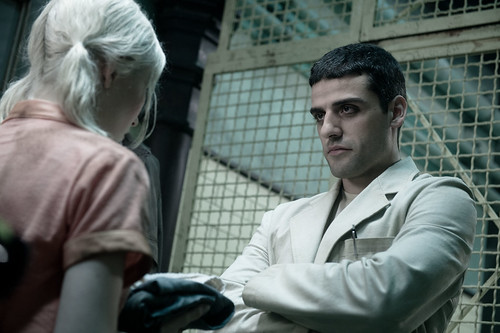
Getting wind of the plot when he overhears Blondie talking to Gorski, Blue locks Sweet Pea in a closet and shoots Amber and Blondie in the head. He then attempts to rape Babydoll[1] but she manages to stab him with the stolen knife (item 3), gets his key (item 4) and uses it to unlock the door holding Sweet Pea. They use the lighter (item 2) to set a fire in the closet, setting off the fire alarms which unlocks the main door. They then escape through the brothel / hospital using the map (item 1) to get to the outside.
Once outside, Babydoll and Sweet Pea find a group of men gathered near the front gate, making a stealthy escape impossible. Sucker Punch then goes all M. Night Shyamalan. Item 5, the great sacrifice, is Babydoll herself. What a twist! Yes, that's the "sucker punch" of the movie. Babydoll isn't the main character at all. This is actually Sweet Pea's escape story.
Sweet Pea, as I mentioned before, is Rocket's older sister. Unlike the other girls in the brothel / hospital, she didn't have a problem "fitting in" in the outside world. She ran away from home to follow Rocket and look after her. Babydoll, whose own little sister died at the beginning of the film when Babydoll tried to rescue her from their creeper stepfather raping her, realizes she has nothing to escape to but Sweet Pea can go home and lead a normal life. And so Babydoll sacrifices herself, distracting the men so Sweet Pea can slip away and board a bus, driven by the Wise Man, home.
Tying up the loose ends, the High Roller is actually the doctor who will perform Babydoll's lobotomy. He performs the procedure but is disturbed by the look in Babydoll's eyes. He asks Dr. Gorski why she signed off on the procedure, which the therapist denies doing. Blue has forged her signature. The police are called and Blue is arrested and nobody but Sweet Pea lives happily ever after.[2]
Pretty depressing stuff for a movie that's just supposed to be BAY-splosions with fetishized girls in skimpy clothing kicking ass. Snyder has advanced as one interpretation of his film that it is a critique of the way geek culture fetishizes women. Unfortunately, Sucker Punch lacks the requisite subversive elements to qualify as a critique. It doesn't subtly or unabashedly twist its fetishized forms to comment on them. It doesn't hyperbolize those figures to the point of absurdity to undermine them. Instead, it puts them into play without challenging the larger edifice of sexism and sexualization in geek culture and culture at large.

Sadism and sexual violence against women? Check. But most of it may not have even happened except in the mind of Babydoll. What does it mean when the principal character is just "making it up"? And the tables aren't turned on Blue or the cook because of their sexual violence. The cops arrest Blue not because he is brutalizing Babydoll (and possibly brutalized the other girls). He is arrested for forging a signature, in effect manipulating the mechanisms of (masculine) medicine for his own selfish gain. And the stepfather gets away free and clear. He attempted to rape both his stepdaughters, youngest is dead, and the only witness to his crimes and rightful inheritor of the future has been lobotomized by his machinations. The violence against women remains hidden and unpunished.
Female sacrifice? Check. I guess at least it wasn't to save her beloved boyfriend, brother, or father. It's to save other girls: sisters and friends. But for all the gunplay, sword fights, martial arts and acrobatics, the girls can't be heroes through their active deeds alone like men. What makes them significant is their ability to sacrifice. This is a standard trope not only in the West but also in Japanese fiction.[3] Rejecting this trope and giving Babydoll the power to free herself by her own hands or at least dying actively trying to escape would have been one way for Sucker Punch to move from merely a geek fetish film to something more akin to a feminist empowerment fairy tale.

Hot girls, particular blondes, in skimpy clothes. Check, check, and check. Why would you wear those outfits into a warzone? Trinity (the Matrix) kicked ass and wore a mean looking jacket and pants while doing it. This problem is also sometimes referred to as the chainmail bikini. Men can armor up from head to toe in plate but a woman fulfilling the same role wears little more than a bikini top and a thong? This is an area of much contention in the universe of video games, an element of the geek culture Snyder is referring to.
I never thought I'd say this, but I wanted to see more Vanessa Hudgens. Jamie Chung, too.[4] Unlike Babydoll, Sweet Pea, and Rocket, their characters (Blondie and Amber) don't even get the outlines of a backstory as to how or why they've ended up in the hospital. It makes Babydoll's assessment that Sweet Pea is the only one who could integrate back into society hollow and without substance. Really, the only reason they seem to be there is to (1) fill in the mission support roles (mech pilot, airplane pilot) and (2) provide eye candy for those who don't like blondes or have a thing for Asians. That "thing for Asians" and these one dimensional characters are yet more examples of how Snyder panders and plays to the fetishes of geek culture rather than critiquing them.

All of this probably sounds like I disliked Sucker Punch, which I didn't. It was a very flawed movie, definitely not the female empowerment film you're looking for. But it did the pretty pictures well. I <3<3<3 the design of minigun wielding giant samurai, the steampunk zombies, and the orcs. Each setting had a strong and unique visual signature and style. And the use of color throughout the film was fantastic, between the muted b&w & gray backgrounds to the more colorful costumes of the girls. These are things Snyder also did really well in 300 and Watchmen.
Sucker Punch fell down because it couldn't be more than a big budget, reality-hopping Roger Corman sexploitation flick, the kind you would see at a grindhouse double feature.[5] But I don't think this kind of action-er starring pretty girls is ultimately doomed to failure. It's possible to have short skirts, BAY-splosions, and still say something thoughtful and subversive about gender roles. Angelina Jolie's character in Sky Captain and the World of Tomorrow illustrates a good way how to do it in an otherwise bland movie.[6]
It's not fair to say I disliked Sucker Punch. I liked it ok. But it had a lot of potential to be something more clever, more transgressive, more interesting. I had high expectations for Zach Snyder's pet project. Instead we got pretty girls battling monsters and machines with a fantasy-within-a-fantasy-within-reality narrative structure firmly entrenched within the confines of Western tropes of gender and reflecting unreflectively the sexual fantasies of geek culture.
No, I didn't dislike Sucker Punch. It just disappointed me.

[1] Which would then deprive her of the value for which she is being sold to the High Roller, but these are the escapist fantasies of a girl on the precipice of being lobotomized so illogic can be forgiven.
[2] Why aren't the police called because 3 of the girls are dead? Ok, maybe not Rocket because that may fall into the category of expected mayhem inside a psych ward. But what about Blondie and Amber, who were shot in the head? How do they die in the real / hospital world? Or are they even dead at all? I didn't see them roaming the halls of the hospital after Babydoll's lobotomy. So many questions but they were quite literally disposable characters.
[3] I've briefly dealt with this before in my primer on anime female types, which itself referenced on article on wussy JRPG girls.
[4] See my review of the Hangover 2 for another film I criticize for underutilizing Jamie Chung and playing up to stereotypes about women, specifically Asian women.
[5] Confession: I haven't seen the Tarantino / Rodriguez double feature Grindhouse. But Tarantino is one who can write strong female characters: Mia Wallace, Jackie Brown, the ladies from Kill Bill, even going back to Mallory in Natural Born Killers and Kate Fuller in From Dusk Till Dawn.
[6] Ling Bai's character, on the other hand, drove me crazy in the movie, though perhaps not so much for the character itself as for her penchant to always take roles playing the exotic erotic of one stripe or another. Always. That said, I did fancy her costume and fighting style. She's a comely 44 year old though it's hard to show that here on the blog because her very large nipples seem to have taken lessons from Houdini on how to escape the confines of her clothes.


Buy stuff online? Why not join ebates and get cashback with every purchase. Search for things on the internet? Bing rewards you for every search and lets you earn gift cards and other rewards. Click on the buttons below to join.
Thursday, June 9, 2011
the hangover 2
I went to see The Hangover 2 yesterday. I haven't seen The Hangover so my opinions of the movie are mostly on its own merits and not how it measures up as a sequel. But I have seen a number of reviews of The Hangover 2, how it compares to the original, and how it falls short both in originality and by making others, the Other in fact, the butt of the jokes this time around.
 Stu Price (Ed Helms) is getting married, this time to a nice Thai girl (played by Jamie Chung, who I last saw playing a teenager in Sucker Punch). Her parents want the wedding to be in Thailand so the Wolf Pack re-unites, reluctantly, to make the trip to Thailand. Although Stu wants to avoid a repeat of their Vegas hijinks, unfortunately the crew wake up in a shitty hotel room and are forced to piece together the previous night's insanity in time to save Stu's wedding.
I don't really want to re-cap the plot here. Go see it if you're so inclined. Like I said at the beginning, I can't really tell you how The Hangover 2 stacks up to the original. But I do have a few words about the groupthink of critical reviews.
In case you haven't heard them, the mantra goes something like this. The Hangover was funny because these mostly average guys were the butt of the jokes. Vegas swallowed them up and spit them out. The Hangover 2, on the other hand, is more mean-spirited because it makes other people the butt of the jokes rather than the Wolf Pack.
The scene many critics point to to drive this point home is the one where the Wolf Pack return to a strip club to try to piece together more of last night. As they interview one of the dancers, things go from bad (Stu cheated on his bride-to-be with a Bangkok stripper) to worse when comments are pieced together to reveal that the stripper is actually a shemale. The scene is complete with a full frontal nudity shot of the very busty ladyboy with penis as well as a few other naked ladyboys walking by to reveal that that's this club's stock in trade.
Much is made of the gross out factor by critics, who feel this scene epitomizes the meanness of the sequel's tone. I take a slightly different view. Yes, the penis reveal is played for shock & discomfort value, but there's not really any meanness about it. Stu freaks out but Phil (Bradley Cooper) calms him down by telling him to just forget it. Phil alludes to lots of terrible things he's done that he's just forgotten. And this seems to be enough for Stu to soldier on through the rest of the Maguffin hunt.

Aside: Is it just me, or is Phil pretty much the same character as Vince Vaughn's Beanie Camplbell in Old School? Maybe that should come as no surprise since both were directed by Todd Phillips.
What I think is important here to note is the lack of malice or deep homophobia. Stu isn't angry at the ladyboy who penetrated him; he doesn't shout slanders or slurs at her and references to the incident later in the film lack virulent disgust. And Phil and Allen (Zack Galifianakis) don't attack Stu's identity based on his gender-bending encounter. Sure, it's not a long meditation on trans identity and gender roles, but this is a gross out comedy, not a contender at Sundance. Given the overall tone of the film, I didn't feel this scene was particularly mean-spirited and if anything, more mature about a hetero man and a ladyboy having sex than most of its audience.
But there are two underlying problems with the movie.
First, there's the lack of consequences. Stu was barebacked by the ladyboy stripper but the possibility of STD transmission doesn't even occur. Too serious for a gross out comedy? Sure. But STDs, including HIV, are a major problem in Thailand's sex work industry. Glossing over it feels irresponsible. In fact, the only worry that Stu et al have is his fiancee finding out that he's cheated. Said ethical dilemma, however, evaporates by the end of the film.
Let's briefly return to the Maguffin. From what I understand of the first film, Doug, the groom-to-be, goes missing in the first film and the Wolf Pack must piece together the previous night in order to find him. In The Hangover 2, Teddy (Mason Lee), Stu's fiancee's younger brother, a 16 year old prodigy at Stanford pre-med and cellist, is the missing Maguffin. Joining them for one beer on the beach, Teddy goes missing after losing a finger this time around.
Ok, back to the no consequences problem. Stu, in a moment of clarity, realizes he has a "demon inside" him, one with a penchant for sex workers of all stripes, apparently. After searching for most of 2 days for Teddy, only to find out the person who says he had him was lying, Stu decided to call off the wedding to save his bride-to-be from the evil that men like him do. Then he puts the pieces together to deduce where Teddy is. Emboldened by his flash of memory, Stu reconsiders his plans to end the relationship and the Wolf Pack rush off to save Teddy.

Teddy has lost a finger, basically ending his career as a surgeon and a cellist. But he isn't upset about it at all. Rather, he considers the evening out fondly even though he can't remember most of it. And when Stu and co finally arrive to the wedding late, Stu owns the "demon inside me" realization, presenting to his soon to be father-in-law as proof positive that he isn't the tasteless mushy rice porridge the man compared him to at the rehearsal dinner toast.
Neither the sister or the father, for whom Teddy is his "prized possession," are at all angry that Teddy has lost a finger and, incredulously, neither blame Stu or his buddies for the permanent maiming of the young ingenue. One ridiculous speech garners Lauren's reconfirmation of love and earns the father's respect. They don't even freaking acknowledge the missing finger!!!
As they are prepared to say their vows, Lauren remains steadfast to Stu, saying that she could grow accustomed to the Mike Tyson-esque tribal tattoo on his face. But she wants to switch sides at the altar so she doesn't have to see it.
So, let's see. Ending up in Bangkok 2 days prior to the wedding. Losing and maiming the youngest child. Bareback anal sex with a ladyboy. Routinely getting so wasted with his buddies that he blacks out. None of these things has consequences for Stu. He ends up marrying the docile Asian girl with the blessing of her father in the end. Um, no. Too many loose ends. Maybe Teddy could see losing his finger as a way to escape his father's pressure, giving him the freedom to pursue his own dreams, but said subplot is not developed and still wouldn't explain why the rest of the family is so nonchalant about the whole thing. These unacknowledged and unresolved tensions left me stupefied. Did they even bother to review this script?

My other problem with the movie is how it treats Bangkok and Asians in general. Lauren is the docile Asian girl.[1] She has only a quick flash of anger at Stu's antics that has little effect. As I mentioned above, she's treated as the docile Asian woman in the exotic erotic fashion. The lush tropical environment as the Wolf Pack arrive and start their misadventures at the resort where the wedding is to take place serve as the perfect backdrop for this fetishized female caricature.
Teddy's non-threatening to everybody but Allen, who doesn't want a new face in the Wolf Pack. It's actually Allen's jealous scheme to remove Teddy from the picture for a few hours that launches the debauched evening. But otherwise Teddy's all smiles and accepting of whatever is inflicted upon him, be it by his father or the Wolf Pack. He's also docile.
And then there's the city. "Bangkok has got him now" is a refrain repeated often as the Wolf Pack look for Teddy. Meaning the city's seedy underbelly won't return Teddy. Bangkok is filled with international gangsters (including an amusing cameo by Joe Rogan), ladyboy hookers, plastic bags of Fanta, drug dealing moneys, and other exotica. It's the "Orient," a far off place of forbidden pleasures and untold dangers.
The only people who actually suffer any consequences as a result of the Wolf Pack are Asians. Mr. Chow (Ken Jeong) ends up arrested by an undercover Interpol agent (Paul Giamatti) who baited the Wolf Pack to present the gangster with false promises to release Teddy. Teddy loses his finger. All Stu gets is a tattoo on his face and Allen has his head shaved. Even the drug dealing monkey takes a bullet while these 3 guys skate through life avoiding all but the most superficial of negative consequences.
The Wolf Pack wins. But really, do we want these guys to?

[1]Yes, there are pictures of Jamie Chung with a lot less clothes floating around the internet. But I wanted to emphasize that she's a very pretty girl from the neck up. Haven't seen her do a lot of acting, but I thought she was woefully underutilized in Sucker Punch, a movie I intended fully to review when I say it in May. Let me make you a promise. Let me talk about the Electric Ballroom in London and the Pains of Being Pure at Heart show next and then I'll give you my 2 cents on Sucker Punch.
Buy stuff online? Why not join ebates and get cashback with every purchase. Search for things on the internet? Bing rewards you for every search and lets you earn gift cards and other rewards. Click on the buttons below to join.

I don't really want to re-cap the plot here. Go see it if you're so inclined. Like I said at the beginning, I can't really tell you how The Hangover 2 stacks up to the original. But I do have a few words about the groupthink of critical reviews.
In case you haven't heard them, the mantra goes something like this. The Hangover was funny because these mostly average guys were the butt of the jokes. Vegas swallowed them up and spit them out. The Hangover 2, on the other hand, is more mean-spirited because it makes other people the butt of the jokes rather than the Wolf Pack.
The scene many critics point to to drive this point home is the one where the Wolf Pack return to a strip club to try to piece together more of last night. As they interview one of the dancers, things go from bad (Stu cheated on his bride-to-be with a Bangkok stripper) to worse when comments are pieced together to reveal that the stripper is actually a shemale. The scene is complete with a full frontal nudity shot of the very busty ladyboy with penis as well as a few other naked ladyboys walking by to reveal that that's this club's stock in trade.
Much is made of the gross out factor by critics, who feel this scene epitomizes the meanness of the sequel's tone. I take a slightly different view. Yes, the penis reveal is played for shock & discomfort value, but there's not really any meanness about it. Stu freaks out but Phil (Bradley Cooper) calms him down by telling him to just forget it. Phil alludes to lots of terrible things he's done that he's just forgotten. And this seems to be enough for Stu to soldier on through the rest of the Maguffin hunt.

Aside: Is it just me, or is Phil pretty much the same character as Vince Vaughn's Beanie Camplbell in Old School? Maybe that should come as no surprise since both were directed by Todd Phillips.
What I think is important here to note is the lack of malice or deep homophobia. Stu isn't angry at the ladyboy who penetrated him; he doesn't shout slanders or slurs at her and references to the incident later in the film lack virulent disgust. And Phil and Allen (Zack Galifianakis) don't attack Stu's identity based on his gender-bending encounter. Sure, it's not a long meditation on trans identity and gender roles, but this is a gross out comedy, not a contender at Sundance. Given the overall tone of the film, I didn't feel this scene was particularly mean-spirited and if anything, more mature about a hetero man and a ladyboy having sex than most of its audience.
But there are two underlying problems with the movie.
First, there's the lack of consequences. Stu was barebacked by the ladyboy stripper but the possibility of STD transmission doesn't even occur. Too serious for a gross out comedy? Sure. But STDs, including HIV, are a major problem in Thailand's sex work industry. Glossing over it feels irresponsible. In fact, the only worry that Stu et al have is his fiancee finding out that he's cheated. Said ethical dilemma, however, evaporates by the end of the film.
Let's briefly return to the Maguffin. From what I understand of the first film, Doug, the groom-to-be, goes missing in the first film and the Wolf Pack must piece together the previous night in order to find him. In The Hangover 2, Teddy (Mason Lee), Stu's fiancee's younger brother, a 16 year old prodigy at Stanford pre-med and cellist, is the missing Maguffin. Joining them for one beer on the beach, Teddy goes missing after losing a finger this time around.
Ok, back to the no consequences problem. Stu, in a moment of clarity, realizes he has a "demon inside" him, one with a penchant for sex workers of all stripes, apparently. After searching for most of 2 days for Teddy, only to find out the person who says he had him was lying, Stu decided to call off the wedding to save his bride-to-be from the evil that men like him do. Then he puts the pieces together to deduce where Teddy is. Emboldened by his flash of memory, Stu reconsiders his plans to end the relationship and the Wolf Pack rush off to save Teddy.
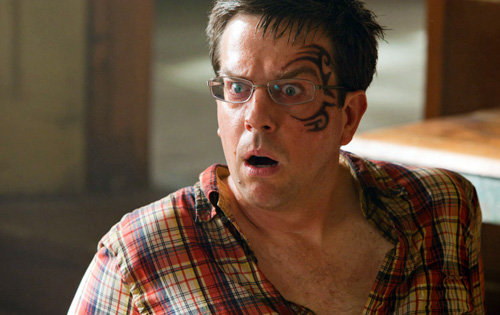
Teddy has lost a finger, basically ending his career as a surgeon and a cellist. But he isn't upset about it at all. Rather, he considers the evening out fondly even though he can't remember most of it. And when Stu and co finally arrive to the wedding late, Stu owns the "demon inside me" realization, presenting to his soon to be father-in-law as proof positive that he isn't the tasteless mushy rice porridge the man compared him to at the rehearsal dinner toast.
Neither the sister or the father, for whom Teddy is his "prized possession," are at all angry that Teddy has lost a finger and, incredulously, neither blame Stu or his buddies for the permanent maiming of the young ingenue. One ridiculous speech garners Lauren's reconfirmation of love and earns the father's respect. They don't even freaking acknowledge the missing finger!!!
As they are prepared to say their vows, Lauren remains steadfast to Stu, saying that she could grow accustomed to the Mike Tyson-esque tribal tattoo on his face. But she wants to switch sides at the altar so she doesn't have to see it.
So, let's see. Ending up in Bangkok 2 days prior to the wedding. Losing and maiming the youngest child. Bareback anal sex with a ladyboy. Routinely getting so wasted with his buddies that he blacks out. None of these things has consequences for Stu. He ends up marrying the docile Asian girl with the blessing of her father in the end. Um, no. Too many loose ends. Maybe Teddy could see losing his finger as a way to escape his father's pressure, giving him the freedom to pursue his own dreams, but said subplot is not developed and still wouldn't explain why the rest of the family is so nonchalant about the whole thing. These unacknowledged and unresolved tensions left me stupefied. Did they even bother to review this script?

My other problem with the movie is how it treats Bangkok and Asians in general. Lauren is the docile Asian girl.[1] She has only a quick flash of anger at Stu's antics that has little effect. As I mentioned above, she's treated as the docile Asian woman in the exotic erotic fashion. The lush tropical environment as the Wolf Pack arrive and start their misadventures at the resort where the wedding is to take place serve as the perfect backdrop for this fetishized female caricature.
Teddy's non-threatening to everybody but Allen, who doesn't want a new face in the Wolf Pack. It's actually Allen's jealous scheme to remove Teddy from the picture for a few hours that launches the debauched evening. But otherwise Teddy's all smiles and accepting of whatever is inflicted upon him, be it by his father or the Wolf Pack. He's also docile.
And then there's the city. "Bangkok has got him now" is a refrain repeated often as the Wolf Pack look for Teddy. Meaning the city's seedy underbelly won't return Teddy. Bangkok is filled with international gangsters (including an amusing cameo by Joe Rogan), ladyboy hookers, plastic bags of Fanta, drug dealing moneys, and other exotica. It's the "Orient," a far off place of forbidden pleasures and untold dangers.
The only people who actually suffer any consequences as a result of the Wolf Pack are Asians. Mr. Chow (Ken Jeong) ends up arrested by an undercover Interpol agent (Paul Giamatti) who baited the Wolf Pack to present the gangster with false promises to release Teddy. Teddy loses his finger. All Stu gets is a tattoo on his face and Allen has his head shaved. Even the drug dealing monkey takes a bullet while these 3 guys skate through life avoiding all but the most superficial of negative consequences.
The Wolf Pack wins. But really, do we want these guys to?

[1]Yes, there are pictures of Jamie Chung with a lot less clothes floating around the internet. But I wanted to emphasize that she's a very pretty girl from the neck up. Haven't seen her do a lot of acting, but I thought she was woefully underutilized in Sucker Punch, a movie I intended fully to review when I say it in May. Let me make you a promise. Let me talk about the Electric Ballroom in London and the Pains of Being Pure at Heart show next and then I'll give you my 2 cents on Sucker Punch.
Buy stuff online? Why not join ebates and get cashback with every purchase. Search for things on the internet? Bing rewards you for every search and lets you earn gift cards and other rewards. Click on the buttons below to join.
Thursday, May 5, 2011
13 assassins
SPOILER warning: Significant plot points are revealed. Read at your own peril.
Walking in to 13 Assassins this evening, I didn't know it was a remake of a 1963 black and white film of the same name directed by Eiichi Kudo. All I knew is that it was a samurai drama (jidaigeki) directed by Takashi Miike. The Miike name was enough to get me to the theater.
Miike is perhaps best known in the West for his disturbing "love story" film Audition and yakuza revenge piece Ichi the Killer. I've also seen Gozu and Dead or Alive 2. Based on these four films and things I've read about his rather lengthy filmography, I had certain expectations going into 13 Assassins. The fact that it didn't meet this expectations in no way is meant to denigrate the film.
13 Assassins is a movie about samurai, plain and simple. While that does mean guys cutting into each other with swords, samurai movies, at least Japanese samurai films, often revolve around a lot more (for instance, see: Twilight Samurai. But see: the 26 original Zatoichi films). Their is imperial politics, the relationship of retainer to lord (and ronin - masterless samurai), honor, family, and such; 13 Assassins pulls in all of these. But there's a good amount of hacking, slashing, bloodshed, and decapitation, too.
The plot, in brief, concerns the assassination of one Lord Naritsugu, son of the previous Shogun and brother to the current. He's a depraved noble, convinced that his birthright gives him not only the right but the duty to rape and murder those whose station in life is to serve him. With the announcement that he will ascend to the rank of Shogun's council and basically be the second-in-command of Japan, a plot is set in motion to make sure he never gets home to take that title. Under secret order from the Shogun, Shinzaemon, a veteran of the Shogun's guard, collects 12 other warriors to help him kill Naritsugu and his army of 200 men at the small town of Ochiai.
There are several of your basic warrior archetypes here. Just to name a few... Hirayama, Shinzaemon's pupil, is the swordsman of unmatched skill. He wields two blades in the final battle a la Miyamoto Musashi and is a general terror. Then there is Ogura, a youth full of devotion but who has never killed a man before. He takes his first life, is shaken by it, and receives reassurance from the more experienced samurai, transitioning him at last into their brotherhood of blood. Shinroukuro is Shinzaemon's nephew, a warrior disillusioned with samurai ways but brought back into the fold, and Sahara, a spear-wielding ronin who fights not for honor, ideals, or his master but demands payment up front to extinguish his debts, take care of his family, and to afford a brief taste of the luxuries he has never known. And then there's Koyata Kiga, a feral hunter released from a trap by the heroes while they are lost in the woods. He guides them back to the road and joins the 12 samurai in the final battle at Ochiai. Unlike them, he fights primarily with the very un-samurai weapon of rocks and slings, either tossing the rocks or using them as a makeshift flail.
 Miike's movies are known for the grotesque, surreal, and sometimes downright ridiculous. The torture scenes in Audition, Ichi's masochism, or pretty much the entirety of Gozu including the brutal murder of a small dog, a cow-headed woman lactating, a suit of human skin, and a woman giving birth to a fully grown man. 13 Assassins has precious little of that. The international version of the film, at 126 minutes, is 15 minutes shorter than the Japanese version. Perhaps Miike's signature shocking imagery and gore were cut either for time or sensitivities of foreign film-goers.
There were a few moments that seemed to show Miike's touch. For instance, one of Naritsugu's examples of cruelty was cutting the arms, legs, and tongue out of the daughter of the peasant who led a revolt against him. She is presented to Shinzaemon fully unclothed, writhing in her painful, pathetic state, to persuade him of the necessity to kill Naritsugu for his inhumanity. And while hiking through the wilderness, Kiga catches a big bug and sucks out its guts. Visually, it's depicted in quite a staid manner. Some members of the assassin's cadre are plague with leeches at one point, but this is mostly played for laughs rather than disgust or silliness.
The sword fights, where I expected to clearly see the hand of Miike at work, were relatively subdued and mild. Like the genre from which it springs, in 13 Assassins, most people are hit with the sword and then fall down to die. Limbs are not dismembered with explosive fountains of blood. Fingers are not chopped off in close up. Nobody gets stabbed through the eye in magnificent CGI glory. People are hit with the sword. They fall down. They die. That's pretty much it.
 There are three notable exceptions. First, in the first example of Naritsugu's cruelty, we seem him attack the young Uneme Makino from behind and repeatedly hack into him. Blood splatter Naritsugu's white kimono with every blow but we don't see the blade hit the body. Young master Makino, a newlywed, had come to investigate why his wife Chise was delayed. Naritsugu had earlier dragged her by her hair across the floor into his room and raped her. The elder Makino, Uneme's father, relates this personal grievance against Naritsugu to Shinzaemon first before revealing the horribly disfigured to elicit the veteran's cooperation.
Second, during the first encounter between the assassins and a band of ronin paid by Naritsugu's retainer Hanbei, Ogura's sword gets stuck in a man after he cuts deeply into his shoulder. Ogura struggles to free his blade while the man attempts to strike him with a short sword. But the gore isn't played up here and it's not meant to be over the top, at least in the international cut.
Third, when Shinzaemon finally faces down his old rival Hanbei at the end of the film, he decapitates the man after admonishing him that they had been equals in skill in the dojo, implying that when the civility of the dojo is gone and it's life or death, Hanbei had always been outmatched. It wasn't just lucky breaks that moved Shinzaemon ahead, as Hanbei alleges, but a real difference in the character of the men. Hanbei's head comes off, but not on screen. We do not see the sword cut through his neck or blood spurt from the wound. Instead, we see the head fly from off screen onto the ground with an absence of arterial blood spray.
 With his final guard defeated, Naritsugu is left to take on the hardened warrior Shinzaemon. Naritsugu kicks the head of his faithful retainer. But this isn't for laughs like the CGI cockfight in DOA2. It's a final example of the utterly malevolent heart of the Lord. Shinzaemon prevails and decapitates his foe but again without a lot of red-dyed corn syrup.
(NOTE: I had to take a bathroom break during the final battle in Ochiai right after Hirayama and Ogura die. I suppose there may have been Miike-type ultra-violence during that 4 minutes I missed.)
All of the assassins save Shinroukuro and Kiga are dead at the close of battle at Ochiai. Kiga runs off to try to woo his beloved Upashi, wife of his boss and the reason he was originally caught in the trap. Shinroukuro, encouraged by his uncle in his dying breath to lay aside samurai ways and do what he wants, considers becoming Japan's greatest bandit or perhaps sailing to America and sleeping with lots of (white) women. The two part ways headed in opposite ways through the bloody, burning carnage of the small town.
Comparisons to The Seven Samurai and The Magnificent Seven are ready. But there's also a more recent American movie that explores similar themes: 300. A charismatic leader, a small band of hardened warriors fighting against an impossibly large odds, swords, a depraved and decadent enemy leader. Both 300 and 13 Assassins are based on supposedly actual historical events. But in 300 the heroes go out stop the enemy from invading their home, therefore assuming a defensive role, the 13 assassins are sent out on a mission to kill Lord Naritsugu. And 13 Assassins obviously hews much more closely to reality than the over the top cinematic action of 300.
One flaw in the movie, one that 15 minutes of cut footage probably wouldn't remedy, is the large number of heroes, for the most part, don't really stand out as individuals. Unlike another recent American movie, Lord of the Rings (or the dwarves that press Bilbo into service in The Hobbit), it's difficult to keep many of the 13 assassins apart. They are initially introduced and then, besides a single-dimension portrait (the comic relief guy, the demolition guys, and others that don't even stand out), they're all guys in dark clothes with swords. But this a criticism that gets leveled a lot of films. Video games, too. The Ocean's 11 remake did a good job of crafting a unique identity for each of the almost as large cast of role-players.
13 Assassins is a great film but it's very much a period piece following the conventions of the genre. It starts out slow, establishing the intricacy of politics, personal relations, and depravity that launch Shinzaemon and his followers on the road to Ochiai. The second third has a little more action as the heroes take to the road, have a limited confrontation, and begin putting their plan into effect to force Naritsugu and his army to Ochiai. The third and final act sees the heroes fortify Ochiai before the epic battle of 13 against 200 unfolds in all its violent, explosive, moving walls, sword swinging glory. No buckets of blood or flying limbs but 13 Assassins is a thoroughly enjoyable, dramatic tale of honor and duty in pre-Meiji Japan.
UPDATE 30 May 2011: You can now pre-order 13 Assassins on DVD or Blu-ray
 .
.
Buy stuff online? Why not join ebates and get cashback with every purchase. Search for things on the internet? Bing rewards you for every search and lets you earn gift cards and other rewards. Click on the buttons below to join.
Walking in to 13 Assassins this evening, I didn't know it was a remake of a 1963 black and white film of the same name directed by Eiichi Kudo. All I knew is that it was a samurai drama (jidaigeki) directed by Takashi Miike. The Miike name was enough to get me to the theater.
Miike is perhaps best known in the West for his disturbing "love story" film Audition and yakuza revenge piece Ichi the Killer. I've also seen Gozu and Dead or Alive 2. Based on these four films and things I've read about his rather lengthy filmography, I had certain expectations going into 13 Assassins. The fact that it didn't meet this expectations in no way is meant to denigrate the film.
13 Assassins is a movie about samurai, plain and simple. While that does mean guys cutting into each other with swords, samurai movies, at least Japanese samurai films, often revolve around a lot more (for instance, see: Twilight Samurai. But see: the 26 original Zatoichi films). Their is imperial politics, the relationship of retainer to lord (and ronin - masterless samurai), honor, family, and such; 13 Assassins pulls in all of these. But there's a good amount of hacking, slashing, bloodshed, and decapitation, too.
The plot, in brief, concerns the assassination of one Lord Naritsugu, son of the previous Shogun and brother to the current. He's a depraved noble, convinced that his birthright gives him not only the right but the duty to rape and murder those whose station in life is to serve him. With the announcement that he will ascend to the rank of Shogun's council and basically be the second-in-command of Japan, a plot is set in motion to make sure he never gets home to take that title. Under secret order from the Shogun, Shinzaemon, a veteran of the Shogun's guard, collects 12 other warriors to help him kill Naritsugu and his army of 200 men at the small town of Ochiai.
There are several of your basic warrior archetypes here. Just to name a few... Hirayama, Shinzaemon's pupil, is the swordsman of unmatched skill. He wields two blades in the final battle a la Miyamoto Musashi and is a general terror. Then there is Ogura, a youth full of devotion but who has never killed a man before. He takes his first life, is shaken by it, and receives reassurance from the more experienced samurai, transitioning him at last into their brotherhood of blood. Shinroukuro is Shinzaemon's nephew, a warrior disillusioned with samurai ways but brought back into the fold, and Sahara, a spear-wielding ronin who fights not for honor, ideals, or his master but demands payment up front to extinguish his debts, take care of his family, and to afford a brief taste of the luxuries he has never known. And then there's Koyata Kiga, a feral hunter released from a trap by the heroes while they are lost in the woods. He guides them back to the road and joins the 12 samurai in the final battle at Ochiai. Unlike them, he fights primarily with the very un-samurai weapon of rocks and slings, either tossing the rocks or using them as a makeshift flail.

There were a few moments that seemed to show Miike's touch. For instance, one of Naritsugu's examples of cruelty was cutting the arms, legs, and tongue out of the daughter of the peasant who led a revolt against him. She is presented to Shinzaemon fully unclothed, writhing in her painful, pathetic state, to persuade him of the necessity to kill Naritsugu for his inhumanity. And while hiking through the wilderness, Kiga catches a big bug and sucks out its guts. Visually, it's depicted in quite a staid manner. Some members of the assassin's cadre are plague with leeches at one point, but this is mostly played for laughs rather than disgust or silliness.
The sword fights, where I expected to clearly see the hand of Miike at work, were relatively subdued and mild. Like the genre from which it springs, in 13 Assassins, most people are hit with the sword and then fall down to die. Limbs are not dismembered with explosive fountains of blood. Fingers are not chopped off in close up. Nobody gets stabbed through the eye in magnificent CGI glory. People are hit with the sword. They fall down. They die. That's pretty much it.

Second, during the first encounter between the assassins and a band of ronin paid by Naritsugu's retainer Hanbei, Ogura's sword gets stuck in a man after he cuts deeply into his shoulder. Ogura struggles to free his blade while the man attempts to strike him with a short sword. But the gore isn't played up here and it's not meant to be over the top, at least in the international cut.
Third, when Shinzaemon finally faces down his old rival Hanbei at the end of the film, he decapitates the man after admonishing him that they had been equals in skill in the dojo, implying that when the civility of the dojo is gone and it's life or death, Hanbei had always been outmatched. It wasn't just lucky breaks that moved Shinzaemon ahead, as Hanbei alleges, but a real difference in the character of the men. Hanbei's head comes off, but not on screen. We do not see the sword cut through his neck or blood spurt from the wound. Instead, we see the head fly from off screen onto the ground with an absence of arterial blood spray.

(NOTE: I had to take a bathroom break during the final battle in Ochiai right after Hirayama and Ogura die. I suppose there may have been Miike-type ultra-violence during that 4 minutes I missed.)
All of the assassins save Shinroukuro and Kiga are dead at the close of battle at Ochiai. Kiga runs off to try to woo his beloved Upashi, wife of his boss and the reason he was originally caught in the trap. Shinroukuro, encouraged by his uncle in his dying breath to lay aside samurai ways and do what he wants, considers becoming Japan's greatest bandit or perhaps sailing to America and sleeping with lots of (white) women. The two part ways headed in opposite ways through the bloody, burning carnage of the small town.
Comparisons to The Seven Samurai and The Magnificent Seven are ready. But there's also a more recent American movie that explores similar themes: 300. A charismatic leader, a small band of hardened warriors fighting against an impossibly large odds, swords, a depraved and decadent enemy leader. Both 300 and 13 Assassins are based on supposedly actual historical events. But in 300 the heroes go out stop the enemy from invading their home, therefore assuming a defensive role, the 13 assassins are sent out on a mission to kill Lord Naritsugu. And 13 Assassins obviously hews much more closely to reality than the over the top cinematic action of 300.
One flaw in the movie, one that 15 minutes of cut footage probably wouldn't remedy, is the large number of heroes, for the most part, don't really stand out as individuals. Unlike another recent American movie, Lord of the Rings (or the dwarves that press Bilbo into service in The Hobbit), it's difficult to keep many of the 13 assassins apart. They are initially introduced and then, besides a single-dimension portrait (the comic relief guy, the demolition guys, and others that don't even stand out), they're all guys in dark clothes with swords. But this a criticism that gets leveled a lot of films. Video games, too. The Ocean's 11 remake did a good job of crafting a unique identity for each of the almost as large cast of role-players.
13 Assassins is a great film but it's very much a period piece following the conventions of the genre. It starts out slow, establishing the intricacy of politics, personal relations, and depravity that launch Shinzaemon and his followers on the road to Ochiai. The second third has a little more action as the heroes take to the road, have a limited confrontation, and begin putting their plan into effect to force Naritsugu and his army to Ochiai. The third and final act sees the heroes fortify Ochiai before the epic battle of 13 against 200 unfolds in all its violent, explosive, moving walls, sword swinging glory. No buckets of blood or flying limbs but 13 Assassins is a thoroughly enjoyable, dramatic tale of honor and duty in pre-Meiji Japan.
UPDATE 30 May 2011: You can now pre-order 13 Assassins on DVD
or Blu-ray
.
Buy stuff online? Why not join ebates and get cashback with every purchase. Search for things on the internet? Bing rewards you for every search and lets you earn gift cards and other rewards. Click on the buttons below to join.
Subscribe to:
Posts (Atom)